
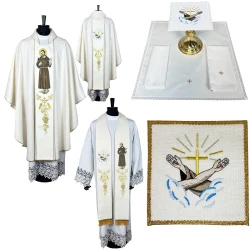


Embroidered Catholic chasubles are the outermost vestments worn by a priest at Mass. They are placed over the alb and the stole, and their color follows the liturgical season. This collection brings together 378 embroidered chasubles in Roman, Gothic and semi-Gothic cuts, in all liturgical colors, from $104 to $1,125. Most listings include a matching stole. The craftsmanship is visible in the embroidery, the fabric and the finish, and every piece is intended for the Catholic liturgy. Use the guides below to compare styles, fabrics, sizes and symbolism before choosing a vestment for your parish.
What Is an Embroidered Liturgical Chasuble?
An embroidered liturgical chasuble is the vestment proper to the priest celebrant at Mass. It is worn over the alb and stole and covers the body from the shoulders to below the knees. The English word comes from the Latin casula (a small hooded cloak); in the Roman tradition the garment developed from the paenula, an everyday outer cloak of antiquity. The chasuble is traditionally understood as a symbol of the yoke of Christ and of the charity that should mark the priest who celebrates the Eucharist (definition after Wikipedia, "Chasuble").
Catholic Chasuble vs Vestment: What Is the Difference?
A vestment is the general name for the liturgical garments worn by clergy and ministers. A chasuble is one specific vestment: the outermost garment worn by the priest at Mass. In other words, every chasuble is a vestment, but not every vestment is a chasuble. The alb, stole, cope, dalmatic and humeral veil are also vestments, each with its own role in the liturgy.
Chasuble vs Cope vs Dalmatic: What Is the Difference?
The chasuble is the priest's Mass vestment, closed at the front and slipped over the head. The cope is a processional cloak with an open front, worn for Benediction, processions and solemn services outside Mass. The dalmatic is the vestment of the deacon, with sleeves and a narrower shape. A priest wears the chasuble; a deacon wears the dalmatic; the cope may be worn by a priest or bishop for processions and expositions of the Blessed Sacrament.
How Much Do Embroidered Chasubles Cost?
Our embroidered chasubles currently range from $104 to $1,125 across all 378 active models in this category. The lowest-priced options are simple designs such as Chasuble with the Jerusalem crosses - violet — $104; the most ornate pieces, such as Embroidered chasuble Jesus on the cross - red (190) — $1,125, sit at the top of the range. Prices are shown in US dollars, and every product has its own listing with the exact price.
Style is the main driver of price. Roman-cut models in this category range from $561 to $1,000 (8 models), Gothic models from $153 to $424 (62 models named Gothic in the title; 74 listings mention a Gothic cut), and semi-Gothic models from $161 to $375 (34 models). Embroidery density, fabric, and the number of matching pieces in a set also move the price within each style.
What Types of Embroidered Liturgical Chasubles Are Available?
Roman (conical) chasubles — the more fitted cut, narrower across the shoulders and often associated with the traditional Roman rite. 8 models in this category, from $561. See the full Roman chasuble collection.
Gothic chasubles — the wider, fuller cut that drapes over the shoulders. 62 models are explicitly named Gothic in this category, and 74 listings describe a Gothic cut, from $153. See the Gothic chasuble collection.
Semi-Gothic chasubles — a middle shape between the fitted Roman and the full Gothic. 34 models, from $161. See the semi-Gothic chasuble collection.
Across all three styles, decorative motifs named in our listings include the IHS christogram (31 models), the Jerusalem cross (8 models), and other cross designs (41 additional models). 28 models name a computer-embroidered belt. Textile options named in our listings include brocade (60 models), damask (64), velvet (64), wool (54), polyester (40), jacquard (15), and one silk model.
How Do I Choose the Right Embroidered Chasuble?
- Start with the liturgical colors. A priest needs chasubles in white, red, green, and violet at minimum; black and rose are optional additions. 274 models in this category are listed in a named liturgical color.
- Decide on the cut first. Roman/conical is the narrowest, Gothic the widest, semi-Gothic in between — choose the silhouette before comparing embroidery.
- Match the stole. 357 of the 378 active listings mention a matching embroidered stole.
- Consider the fabric. Brocade, damask, velvet, wool, polyester and jacquard behave differently in drape, weight and cleaning. The fabric should suit the climate and the parish's care routine.
- Check availability. All 378 models in this category are currently in stock.
What Liturgical Colors Are Available?
Embroidered chasubles are made in all the liturgical colors:
White (or gold) — Easter, Christmas, feasts of the Lord, feasts of the Blessed Virgin Mary, angels, and saints who were not martyrs.
Red — Palm Sunday, Good Friday, Pentecost, celebrations of the Lord's Passion, feasts of the apostles and evangelists, and martyrs.
Green — Ordinary Time, the longest liturgical season.
Violet (purple) — Advent and Lent, the sacrament of Reconciliation, and funerals.
Black — optional, All Souls' Day and funerals.
Rose — optional, Gaudete Sunday (Third Sunday of Advent) and Laetare Sunday (Fourth Sunday of Lent).
Shop by color: white chasubles, red chasubles, green chasubles, purple chasubles, black chasubles, pink (rose) chasubles, gold chasubles, and ecru chasubles.
What Fabrics Are Used in Embroidered Chasubles?
The fabric affects drape, weight, sheen and care. In this collection, the most frequently named fabrics are damask (64 models), velvet (64), brocade (60), wool (54), polyester (40) and jacquard (15). One model is described as silk. Damask and jacquard are woven fabrics with a patterned surface; brocade is heavier and often uses metallic thread; velvet has a soft pile and a rich appearance; wool blends add warmth and body; polyester is lightweight and easy to care for. Always check the individual product page for the exact composition and care instructions.
What Sizes Do Embroidered Chasubles Come In?
Most listings in this collection give a finished size of 127 × 158 cm (103 listings) or 130 × 160 cm (99 listings). Some shorter models are described with a 125 cm length (43 listings). These measurements usually refer to the width across the shoulders and the length from the shoulder to the hem. Fit depends on the cut: a Roman chasuble sits closer to the body, while a Gothic chasuble drapes more fully. Check the size on the individual product page before ordering, especially for a parish with several priests or a sacristan ordering for a specific celebrant.
What Do the IHS and Jerusalem Cross Mean on a Chasuble?
IHS is a christogram derived from the Greek name of Jesus (ΙΗΣΟΥΣ). It appears on 31 chasubles in this collection, often embroidered in gold on the front or back. The Jerusalem cross — a large cross with four smaller crosses in the quarters — appears on 8 models and is associated with the Holy Land and the Crusades. Other cross designs appear on 41 additional models. These motifs are not decoration for its own sake: they identify the vestment as a liturgical garment and direct attention to the mystery celebrated at Mass. The same symbolism runs through the Alpha and Omega, the Lamb of God and the PAX monogram.
How Many Chasubles Does a Priest Need?
At minimum, a priest needs the four main liturgical colors — white, red, green, and violet. Many also add black (funerals and All Souls) and rose (Gaudete and Laetare Sundays). A parish with several priests, or one that hosts concelebration and multiple Sunday Masses, usually keeps duplicates in the most-used colors. A practical starting point is one chasuble per color per celebrant, plus a spare white or green for busy seasons.
Can a Priest Say Mass Without a Chasuble?
Normally, no. The General Instruction of the Roman Missal (GIRM 336) names the chasuble as the vestment proper to the priest celebrant at Mass. Exceptions are limited: at concelebration, priests other than the principal celebrant may wear the stole and alb; and a priest may wear a cope for non-Eucharistic services such as Benediction or processions. For the celebration of Mass itself, the chasuble is the normal and expected vestment.
How Do You Care for an Embroidered Chasuble?
Store chasubles on wide hangers to keep their shape, and avoid sharp folds — roll rather than crease if you must store them flat. Most embroidered chasubles are dry clean only; always check the care label. When traveling, use a garment bag so the embroidery does not snag or gather dust. Keep velvet and brocade away from prolonged direct sunlight, and repair loose threads before they pull the embroidery.
Frequently Asked Questions About Chasubles
Q: How do you pronounce chasuble?
A: Chasuble is pronounced CHAZ-yuh-bul (/ˈtʃæzjʊbəl/). The stress is on the first syllable.
Q: Can deacons wear chasubles?
A: No. Deacons wear a dalmatic, not a chasuble; the chasuble is the vestment of the priest celebrant at Mass.
Q: What is the difference between a Roman and a Gothic chasuble?
A: A Roman (conical) chasuble is more fitted and narrower; a Gothic chasuble is wider and drapes more fully over the shoulders. The semi-Gothic cut is the middle ground between the two. See the Roman, Gothic and semi-Gothic collections.
Q: Where are your chasubles made?
A: Our chasubles are made in Poland. Each product page names the fabric and motif of the individual model.
Q: Do chasubles come with a matching stole?
A: Most do. 357 of the 378 active listings mention a matching stole; check the individual product page to confirm what is included.
Q: Are all chasubles in stock?
A: Yes — all 378 active models in this category are currently in stock. Availability is shown on each product page and may change during busy liturgical seasons.
Browse Our Chasuble Collection
Explore our full selection of embroidered liturgical chasubles in Roman, Gothic, and semi-Gothic styles, in all liturgical colors and with matching stoles. We also offer dalmatics for deacons and copes for processions. Chasubles are worn over the alb and stole.
Shop by style and occasion: Roman chasubles · Gothic chasubles · semi-Gothic chasubles · Marian chasubles · chasubles with saints · wedding chasubles · Christmas chasubles · Easter chasubles.
Matching Marian stoles: for the feasts of Our Lady, our Marian stoles are made to match these chasubles.
Storage: keep each chasuble on a wide wooden vestment hanger to support the full shoulder line and prevent creases between Masses.
To dress the ambo in the same liturgical color as the chasuble, see our embroidered lectern and pulpit covers.
Related Reading
- Chasuble vs Vestment: What's the Difference?
- Can a Priest Say Mass Without a Chasuble?
- Chasuble Sizes and Fit: How to Measure for a Priest's Vestment
- The IHS Symbol on a Chasuble: Meaning and History
- How to Choose a Chasuble: Complete Guide for Priests and Sacristans
- Roman Chasuble vs Gothic Chasuble: Key Differences Explained
- How Much Does a Chasuble Cost? Price Ranges Explained
- The History of the Chasuble: From Ancient Rome to Modern Altars
- Humeral veils for Benediction — the shoulder veil worn with the cope when the Blessed Sacrament is exposed.
Summer option: for warm churches and outdoor Masses, see our linen chasubles — 75% linen, 125 cm, matching stole included.
