


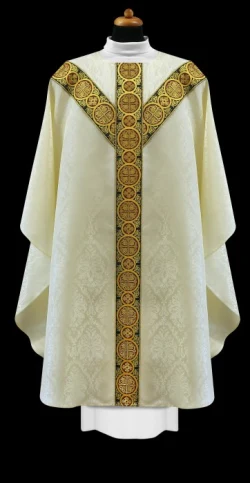


What Are Semi-Gothic Chasubles?
A semi-Gothic chasuble is the middle cut between the full Gothic vestment and the short Roman (fiddleback) chasuble: it keeps the flowing front and the wide drape of the Gothic shape, but removes some of the volume so the priest can move and raise his hands freely. This collection gathers 48 semi-Gothic chasubles, priced from $161.00 to $1,270.10; most models sit between $200 and $499.99. Every vestment is made in Poland and is supplied with a matching inner stole. Most of the range follows the 127 × 158 cm pattern; the made-to-order and exclusive models use their own measurements, listed on each product page.
Semi-Gothic vs Gothic vs Roman Chasuble
The three names describe the same garment in different cuts. A Gothic chasuble is the widest and longest, with a free-falling drape that covers the arms almost to the wrist (see the Gothic chasubles collection). A Roman or fiddleback chasuble is the shortest and most structured, cut close to the shoulders. The semi-Gothic cut sits between them: it keeps the broad, flowing look of the Gothic style while reducing the volume, which makes it practical for everyday parish use as well as solemn celebrations. If you are unsure which cut suits your sacristy, the guide How to Choose a Chasuble walks through the differences, and Roman vs Gothic Chasuble explains the history behind each shape.
Design and Fabrics: Damask, Brocade, Jacquard and Velvet
The range is built on four fabric families. Descriptions across the collection mention damask on 19 models, brocade on 10, jacquard on 8 and a smooth plain weave on 6; several models combine two fabrics. Damask gives a reversible figured pattern with a soft sheen, brocade adds a heavier decorative weave, jacquard produces a crisp raised pattern, and plain weave keeps the vestment light and crease-resistant. Velvet appears on 25 models, usually as velvet stripes or a velvet panel down the centre, finished with gold tape or metallic thread. The result is a vestment that reads as traditional from the nave but remains comfortable for a full Mass.
Orphrey, Embroidery and the Matching Stole
The centre of each chasuble is finished with decorative bands, the orphrey, which carries the embroidery and gives the vestment its liturgical character. Across the collection, IHS monograms appear on 8 models and the Alpha and Omega motif on 3, usually worked in gold metallic thread. Every one of the 48 chasubles is supplied with a matching inner stole, so the priest has the stole that belongs with the vestment instead of buying it separately. If you need a separate stole for another colour, see the embroidered liturgical stoles.
Dimensions and Fit
Sizing is not identical across the whole range. 39 of the 48 models follow the classic semi-Gothic pattern of 127 cm (50 in) in length and 158 cm (62.2 in) in width. A few older models use a 130 × 160 cm pattern, while the made-to-order and exclusive vestments use a shorter 125–130 cm length with a 60–65 cm arm measurement. Always check the measurements on the individual product page before ordering, and use the size guide if you are comparing a new vestment with one already in the sacristy.
Liturgical Colours
Semi-Gothic chasubles are worn in the colour proper to the day or season: white and gold for solemnities and feasts, red for Pentecost and martyrs, green for Ordinary Time, violet and rose for Advent and Lent, and black where the older use is observed. The collection includes green, red, purple, pink, gold, silver, ecru and cream models, plus multi-colour sets; the product names list the colour of each vestment. You can also browse the colour collections directly: red chasubles, pink chasubles, ecru chasubles, black chasubles, white chasubles, green chasubles, purple chasubles and gold chasubles.
What Comes in the Set
Each semi-Gothic chasuble in this collection includes a matching inner stole. The stole is the vestment the priest wears around the neck; the chasuble is the outer garment. Some sacristies also use a maniple (a small band worn on the left arm in the older use), a burse (the folded case for the corporal) and a dalmatic for the deacon. Those pieces are not part of every set, so check the individual listing; matching dalmatics and burses are available separately.
Care, Cleaning and Storage
The older polyester models are described as breathable, crease-resistant and suitable for standard washing and ironing, while the made-to-order and exclusive vestments are dry clean only. Always follow the care label attached to the vestment. Never iron directly over embroidery, velvet or gold thread; use a pressing cloth and a cool setting. Store the chasuble on a wide padded hanger rather than a wire one, close the vestment bag to keep out dust, and avoid folding the embroidered centre for long periods. For detailed advice, see How to Care for Embroidered Vestments.
Price, Making Time and Shipping
Prices in this collection run from $161.00 to $1,270.10. Three models are under $200, 15 are priced $200–$299.99, 27 are $300–$399.99, two are $400–$499.99, and one exclusive gemstone model is $1,270.10. Each vestment is made in Poland. Items held in stock are dispatched within 72 hours; made-to-order models take an additional 3–14 business days before dispatch, and the exclusive made-to-order pieces take 3–4 weeks. FedEx delivery normally follows within 2–5 business days. Shipping costs are calculated at checkout by weight and destination; full details are in the shipping information and the returns policy (21 days).
History and Continuity
The chasuble has been the priest's outer vestment since late antiquity, evolving from a simple conical cloak into the richly decorated forms worn today. The semi-Gothic shape is a modern reading of that tradition, keeping the historic full drape while answering the practical needs of the modern sanctuary. For the wider story, read The History of the Chasuble and The Evolution of Liturgical Vestments; parishes planning to refresh a vestment set may also find How Often Should Vestments Be Replaced useful. The close-fitting counterpart is the traditional Roman chasuble for the Latin Mass, and many of our Marian chasubles are cut semi-Gothic. For the Sacrament of Marriage, see the wedding chasubles in white, cream and gold.
Frequently Asked Questions
What is a semi-Gothic chasuble?
A semi-Gothic chasuble is a Catholic priest's outer vestment cut between the full Gothic and the short Roman shape. It keeps the flowing front and broad drape of the Gothic chasuble but removes some of the width, so it sits comfortably over the shoulders and leaves the arms freer during Mass.
How is a semi-Gothic chasuble different from a Gothic chasuble?
A Gothic chasuble is wider and longer, covering the arms almost to the wrist. A semi-Gothic chasuble keeps the same silhouette but is narrower and lighter, which makes it easier to wear for everyday parish Masses. See the Gothic chasubles collection for the fuller cut.
How is it different from a Roman chasuble?
A Roman or fiddleback chasuble is shorter, stiffer and cut close to the shoulders. The semi-Gothic vestment is fuller and softer, closer to the Gothic tradition. The Roman chasubles collection shows the close-fitting alternative.
What size is a semi-Gothic chasuble?
Most models in this collection are 127 cm (50 in) long and 158 cm (62.2 in) wide. Some older models are 130 × 160 cm, and the made-to-order or exclusive vestments use a 125–130 cm length with a 60–65 cm arm measurement. The exact size is listed on each product page.
What fabrics are used?
The collection uses damask, brocade, jacquard and plain-weave fabrics, often with velvet stripes or a velvet panel. Damask and brocade give a richer sheen, jacquard a crisp raised pattern, and plain weave a light, crease-resistant finish. Each listing names the fabric of that vestment.
Does the chasuble come with a stole?
Yes. Every semi-Gothic chasuble in this collection is supplied with a matching inner stole. The stole is included in the price; you do not need to order it separately.
What is an orphrey?
An orphrey is the decorative band running down the centre of the chasuble. It carries the embroidery, such as the IHS monogram or the Alpha and Omega symbol, and is usually worked in gold metallic thread or trimmed with velvet and gold tape.
What is the difference between damask, brocade and jacquard?
Damask is a reversible figured fabric with a soft sheen; brocade is a heavier decorative weave with raised motifs; jacquard is a woven pattern produced on a jacquard loom. All three appear in this collection, and some vestments combine them with a plain-weave base.
Which liturgical colours are available?
The collection includes green, red, purple, pink, gold, silver, ecru and cream vestments, plus multi-colour sets. White and black are available through the colour collections and made-to-order options. Choose the colour proper to the day or season.
How much does a semi-Gothic chasuble cost?
Prices range from $161.00 to $1,270.10. Most models cost between $200 and $499.99; the exclusive gemstone chasuble is $1,270.10. The price includes the matching inner stole.
How long does delivery take?
In-stock items are dispatched within 72 hours. Made-to-order models take 3–14 business days before dispatch, and the exclusive made-to-order pieces take 3–4 weeks. FedEx delivery normally follows within 2–5 business days.
How should I care for and store a semi-Gothic chasuble?
Follow the care label. Most older polyester models can be washed and ironed according to the label, while made-to-order and exclusive vestments are dry clean only. Never iron directly over embroidery, velvet or gold thread; store the vestment on a padded hanger in a dust bag.
Can a semi-Gothic chasuble be worn for the Latin Mass?
Yes. The semi-Gothic cut is widely used for both the Ordinary Form and the Extraordinary Form. For a more pronounced traditional look, the Roman chasuble is the closer fit; for a fuller cut, see the Gothic chasubles.
Who wears a semi-Gothic chasuble?
A Catholic priest wears the chasuble when celebrating Mass. The semi-Gothic cut is popular in parishes because it balances the traditional flowing look with a lighter, more practical drape for everyday use.
Do you offer matching dalmatics or burses?
Matching dalmatics and burses are available separately. Check the individual product page or contact us with the fabric and colour you need.
Is the chasuble made in Poland?
Yes. The vestments in this collection are made in Poland. In-stock items ship within 72 hours; made-to-order pieces are produced to order and take 3–14 business days, or 3–4 weeks for the exclusive models.
Explore More Catholic Liturgical Items
Browse the parent embroidered chasubles collection, the Gothic chasubles, the Roman chasubles, the Marian chasubles and the wedding chasubles. For the vestments worn underneath, see the stoles, and for the story behind the garment, read The History of the Chasuble. Our made-in-Poland page explains how the vestments are produced.
Related: the chasubles with saints — 142 models from $192.
Summer option: for warm churches and outdoor Masses, see our linen chasubles — 75% linen, 125 cm, matching stole included.
