


What Is a Holy Water Pot (Aspersorium)?
A holy water pot — in liturgical use called an aspersorium, and in everyday speech a holy water bucket, vessel, container, or holder — is the portable vessel that holds the water a priest sprinkles with the holy water sprinkler, the aspergillum, during the Rite of Asperges, the blessing of homes, and the sprinkling of the faithful. The word aspersorium comes from the same Latin verb as the sprinkler, aspergere, "to sprinkle": the aspersorium holds the water, the aspergillum throws it. During the Asperges the priest carries the aspersorium in one hand and the aspergillum in the other, and between uses the sprinkler rests inside the pot.
Aspersorium, Stoup, Font, or Bucket — the Names Explained
The same vessel goes by several names in English, and they are often used loosely. Here is how they differ:
- Aspersorium — the formal liturgical name for the portable pot or bucket that holds the water for sprinkling. It is often fitted with an insert or sponge that holds the aspergillum between uses.
- Holy water bucket — the everyday name for the same vessel, used especially for the large handled buckets carried in processions and at the blessing of homes.
- Stoup — a small vessel, usually wall-mounted, fixed at the church or home entrance so the faithful can bless themselves on the way in.
- Holy water font — the general name for the vessel that holds holy water, from the small entrance stoup to a large church font. Older texts also write fount — a variant of the same word, not a different vessel.
- Holy water container, holder, or receptacle — the plain-English terms people use for any clean, non-corrosive vessel kept for holy water.
A baptismal font is a different vessel again: the large basin, fixed in the baptistery, in which baptism is administered. Many baptismal fonts are octagonal — eight sides recalling the "eighth day," the day of the Resurrection and the new creation that baptism begins. The aspersorium never replaces the font: the pot carries water for blessing and sprinkling, while the font is the place of the sacrament itself.
The Rite of Asperges: When the Pot Is Used
The aspersorium belongs first of all to the sprinkling rite that opens Sunday Mass in many churches. The priest, vested in cope, carries the pot in one hand and the holy water sprinkler in the other; he sprinkles the altar first, then the clergy and the congregation, while the choir sings the antiphon Asperges me — "You shall sprinkle me with hyssop, and I shall be cleansed" (Psalm 51). In the Ordinary Form this sprinkling may replace the Penitential Act; in the Extraordinary Form it precedes every Sunday Mass.
In Eastertide the same rite continues under another name: the Vidi aquam — "I saw water flowing from the right side of the temple" (Ezekiel 47). The change of chant is the point: during Easter the Church sprinkles the people with water blessed at the Easter Vigil, the water of the baptismal font, and the antiphon celebrates the living water that flows from the risen Christ.
The pot travels far beyond Mass as well: the blessing of homes during Eastertide, the blessing of graves, processions, the blessing of objects, and visits to the sick all call for the aspersorium and aspergillum together.
Types of Holy Water Pots
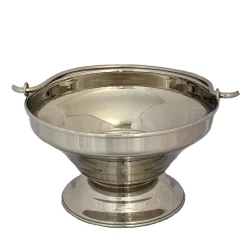
Our range covers the forms most used in parishes and homes: a stainless steel bucket-kettle ($201) for carrying and pouring water, a polished nickel bowl-jug, 19 cm (7.5 in) ($242), for the sacristy, and a complete pot-and-sprinkler set ($383) — a 30 cm (11.8 in) brass pot, nickel-plated in silver, with a 29 cm (11.4 in) holy water sprinkler with a wooden handle. The set's pot has a protective inner bowl and a sponge dropper inside, and the sprinkler has a hanging handle so the two pieces stay together.
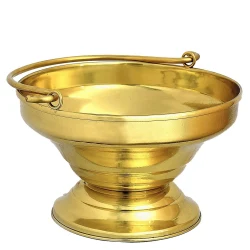
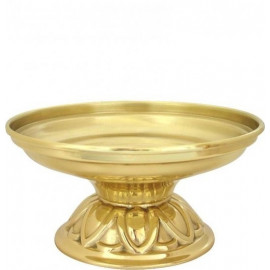
For churches that need something larger, we also offer a gold-finished brass pot (15 cm / 5.9 in) and two big decorative pots for holy water — 41 cm (16.1 in) and 44 cm (17.3 in) high, cast and polished in brass. These larger pieces are currently made to order: contact us for availability.
Holy Water Pot with Sprinkler Set
Most parishes and many homes want the two vessels together, and our complete holy water pot with sprinkler set is built for exactly that pairing. The pot stands 30 cm (11.8 in) high and is made of brass nickel-plated in silver; inside sits a protective plastic inner bowl — the liner that keeps the metal clean — and a sponge dropper. The holy water sprinkler measures 29 cm (11.4 in), has a turned wooden handle and a hanging loop, and rests upright in the pot between uses, so the two pieces travel as one. It is the same arrangement a sacristy keeps ready for the Rite of Asperges, the blessing of homes, and the sprinkling of the faithful.
If you already own one half of the pair, buy only the other: every aspergillum in our collection fits these pots, and any of the pots takes a standard sprinkler.
Materials, Finishes, and Craftsmanship
Holy water vessels must be non-corrosive and easy to keep clean. Ours are made from brass, nickel-plated metal, and stainless steel, turned and polished by hand — made in Poland and Italy, in the same workshops behind our chalices and censers.
Finishes follow the metal: high-polish brass with a warm gold tone, gold-finished brass, nickel plating in bright silver, and polished stainless steel for everyday carrying. Brass and gold pieces are polished and protected with a clear, heat-cured finish — the varnish is baked at high temperature, so it lasts for years — and ask only for a wipe with a dry, soft cloth. Nickel-plated and stainless steel surfaces can be washed with mild soap and water, then dried at once.
Sizes, Capacity, and Choosing the Right Pot
For a home or a small chapel, a 1–2 liter pot with a 9–17 cm (3.5–6.7 in) sprinkler is ample — the stainless steel kettle and the 19 cm (7.5 in) bowl-jug both fit this role. For a parish church, choose a deeper aspersorium that lets a 20–26 cm (7.9–10.2 in) sprinkler rest inside it between uses; the 30 cm (11.8 in) pot of our complete set is sized exactly for that. Sacristies often keep a bowl-jug for refilling fonts, while the big 41–44 cm (16.1–17.3 in) pots serve processions, the blessing of homes, and churches that keep a full aspersorium in the sanctuary.
Specifications at a Glance
| Piece | Height | Width / Diameter | Material & Finish | Notes | Price | Availability |
|---|---|---|---|---|---|---|
| Complete pot-and-sprinkler set | 30 cm / 11.8 in (pot) | — | Brass, nickel-plated in silver | Sprinkler 29 cm / 11.4 in, wooden handle; inner bowl (liner) + sponge dropper | $383 | In stock |
| Stainless steel bucket-kettle | — | — | Polished stainless steel | For carrying and pouring; pairs with 9–26 cm sprinklers | $201 | In stock |
| Bowl-jug (sacristy) | 19 cm / 7.5 in | 19 cm / 7.5 in | Polished nickel | Made in Italy; for refilling fonts and blessings | $242 | In stock |
| Gold holy water pot | 7.5 cm / 2.95 in | 15 cm / 5.9 in | Gold-finished brass, heat-cured varnish | Traditional round base | $200 | Made to order |
| Large holy water pot | 41 cm / 16.1 in | 22 cm / 8.7 in | Brass castings, polished and varnished | For processions and sanctuaries | $424 | Made to order |
| Decorative holy water pot | 44 cm / 17.3 in | 31.5 cm / 12.4 in | Brass, polished and lacquered | Cast decorative form | $564 | Made to order |
Choosing a Container for Holy Water
Holy water does not require a consecrated container, but it should be kept in a clean, non-corrosive vessel reserved for this purpose: glass, ceramic, or the metals of our pots — brass, nickel, stainless steel. Avoid vessels that rust or have held other liquids, and avoid keeping the water in an open cup where dust settles and it evaporates quickly; a pot with a lid or liner, or a metal bucket with a removable inner bowl, is easiest to keep clean. The water itself is a sacramental: it is blessed by a priest, it is not for drinking, and when it must be discarded it is poured into a sacrarium — the special sink found in every sacristy — or onto the ground, never down an ordinary drain.
How to Use and Care for a Holy Water Pot
Fill the pot with water blessed by a priest, and keep the sprinkler resting in it or beside it. Refresh the water regularly — at least monthly, or sooner if it becomes cloudy — pouring the old water into a sacrarium or onto the ground. Between uses, keep the vessel covered where possible; where the pot has a liner or inner bowl, lift it out and rinse it separately. Before storing the vessel for a long period, empty it and dry it thoroughly so no moisture dulls the finish. Wipe brass and nickel surfaces with a soft cloth; a light silver polish is enough for silver-toned pieces, and abrasive cleaners should be avoided.
Holy Water, Baptism, and the Blessing of Water
Holy water is water blessed by a priest for the blessing of persons, places, and objects — and its most solemn form is the blessing of the baptismal water at the Easter Vigil, when the Easter candle is plunged into the font and the people are sprinkled with the newly blessed water. Every sprinkling with the aspersorium carries that memory: the Church recalls the washing of baptism and gives thanks for it. The baptismal font remains the vessel of the sacrament; the pot and aspergillum bring the same water to the faithful, to homes, and to graves throughout the year.
Holy Water in the Life of the Church
The aspersorium belongs to a family of holy water vessels: the font at the entrance of the church, where the faithful bless themselves; the small stoup at the door of the home; and the pot that carries the water for blessings. Its great moment is the sprinkling rite — the Asperges before Sunday Mass and the Vidi Aquam in Eastertide — when priest, sprinkler, and pot together renew the memory of Baptism. The same vessels serve at the blessing of homes and graves, in processions, and in family prayer: read our guides to what an aspergillum is, to choosing a holy water font, and to blessing your home with holy water. For the sprinkler that completes the set, see the aspergillum collection, and for the fixed vessels, the holy water fonts.
Frequently Asked Questions About Holy Water Pots
What is an aspersorium?
An aspersorium is the vessel — a pot, bucket, or bowl — that holds the holy water a priest sprinkles with the aspergillum. The word comes from the Latin aspergere, "to sprinkle."
What is a holy water pot called?
Its formal name is an aspersorium; in everyday use it is called a holy water bucket, vessel, container, or holder. A fixed vessel at the church entrance is a stoup or holy water font.
What is the bucket that holds holy water called?
The bucket that holds holy water is called an aspersorium — literally "the sprinkler's vessel." Large handled aspersoriums are carried in processions and at the blessing of homes.
Is a stoup the same as an aspersorium?
Not quite. A stoup is fixed (usually wall-mounted) at the entrance for the faithful to bless themselves; an aspersorium is portable and travels with the priest for the sprinkling rite.
What holds the holy water in a Catholic church?
At the entrance, a stoup or font holds holy water for the congregation. For the sprinkling rites, the priest uses a portable pot — the aspersorium — carried together with the aspergillum.
Do I need a special container for holy water?
No special blessing is required for the container, but it should be clean, non-corrosive, and used only for holy water — glass, ceramic, or a metal vessel such as the brass, nickel, or stainless steel pots in this collection.
Can you put holy water in any container?
Any clean vessel kept exclusively for holy water will do in a pinch; for regular use, choose one that does not rust or taint the water, with a lid or liner to keep out dust. Metals like brass, nickel, and stainless steel are traditional for good reason.
Is it okay to keep holy water at home?
Yes — the Church encourages it. Many families keep a small font or bottle of holy water near the door and use it when entering and leaving, and for blessing the home, especially in Eastertide.
Is it legal to buy holy water?
The vessels are sold openly everywhere; the water itself is a sacramental, blessed by a priest and normally received from your parish, often free of charge. Catholic practice is to obtain holy water from the Church and keep it in a vessel like the pots in this collection.
Where can I buy a holy water pot?
Right here: our aspersoriums, buckets, and pot-and-sprinkler sets are handmade in Poland and Italy and ship from the United States warehouse with free shipping over $100. See the collection above.
How much does a holy water pot cost?
In our collection, prices run from $201 for the stainless steel bucket-kettle, through $242 for the polished nickel bowl-jug, to $383 for the complete brass pot-and-sprinkler set. Larger decorative brass pots for churches are made to order.
What size holy water pot do I need?
For a home or a small chapel, a 1–2 liter pot with a 9–17 cm (3.5–6.7 in) sprinkler is ample. For a parish church, choose a deeper aspersorium that lets a 20–26 cm (7.9–10.2 in) sprinkler rest inside it between uses.
How often should holy water be changed?
Refresh it regularly — at least monthly, or sooner if it becomes cloudy or develops an odor. The old water is poured into the sacrarium or onto the ground, never into the drain.
How do you clean a brass holy water pot?
Brass pots in our range carry a clear, heat-cured protective finish: dust them with a dry, soft cloth and never use water, chemicals, or abrasive pads, which would strip the finish. Nickel and stainless steel pieces can be washed with mild soap and water and dried immediately.
Can the aspergillum stay in the pot between uses?
Yes — that is the traditional arrangement, and the complete set we offer includes a sponge dropper that holds the sprinkler upright in the pot. Shake the aspergillum gently over the pot before use so the water falls back where it belongs.
Can a regular Catholic make holy water?
No — holy water is blessed by a priest; the blessing belongs to the ordained ministry. The faithful receive it from their parish, usually free of charge, and keep it in a clean vessel like the pots in this collection.
Where should you put holy water in your house?
Most families keep it near the main entrance — a small wall font or stoup, or a bottle on a shelf by the door — so everyone can bless themselves on the way in and out. A bedroom or prayer corner is a common second place; see our holy water fonts for wall and table options.
Can I sprinkle holy water on myself?
Yes. Any of the faithful may use holy water to bless themselves with the Sign of the Cross, and to sprinkle a room or an object. The aspergillum makes this easy: dip it in the pot and shake it gently toward what you are blessing.
Where can I get holy water?
From your parish church — normally free of charge. Bring a clean bottle or vessel; most churches keep holy water at the entrance fonts and refill them at Easter and before major feasts. A priest can also bless water for you in the sacristy.
How do churches get their holy water?
The priest blesses it — at the Easter Vigil, before Sunday Mass, or with the simple rite from the Roman Ritual — and it is poured into the entrance fonts. Larger churches keep a supply in aspersoriums, buckets, and jugs like the ones in this collection to refill the fonts and to carry water for blessings and processions.
What is a holy water dispenser called?
At church entrances, a modern dispenser — a stainless steel tank with a push-button spigot — often replaces the open basin; the traditional portable vessel is still the aspersorium, and the fixed basin is the stoup or font. All three hold the same blessed water.
Is it baptismal font or fount?
"Font" is the standard spelling; "fount" is an older variant of the same word. Both name a basin that holds water — a baptismal font for the sacrament of baptism, a holy water font or stoup for the blessed water at the door.
What is holy water put in?
Any clean, non-corrosive vessel kept for that purpose: a glass or ceramic bottle, or a metal pot, bucket, or font. Our aspersoriums are made of brass, nickel-plated metal, and stainless steel precisely so the water stays clean and the vessel lasts.
