


What Is a Monstrance Veil?
A monstrance veil is a cloth that covers the monstrance — the vessel that holds the consecrated host for exposition and Benediction. The veil is draped over the monstrance when the Blessed Sacrament is not exposed, and it is removed before adoration begins. It protects the vessel from dust and marks reverence for the Blessed Sacrament.
Monstrance veils are sometimes searched as monstrance covers. In practice, the term covers several objects: a light tulle veil, an embroidered fabric veil, or a rigid travel case. This category contains fabric monstrance veils in 90, 100, 120 and 140 cm lengths.
Our monstrance veils are made of fine tulle or embroidered fabric. The tulle is light enough to see the monstrance beneath, while the embroidered edge adds a visible sacred motif. Prices start at $23.
Monstrance Veil vs Humeral Veil
The two names are often confused, but they describe different objects.
- Monstrance veil — a cloth draped over the monstrance itself. It is not worn by the priest.
- Humeral veil — a long, narrow veil worn over the priest's or deacon's shoulders during Benediction and processions. It is typically about 2.75 m long and 90 cm wide, and the minister uses it to hold the monstrance without touching it with bare hands.
If you are looking for the garment worn over the shoulders, see our humeral veils. If you need the cover for the monstrance, you are in the right category.
Monstrance Veil vs Ciborium Veil and Chalice Veil
Three veils are used in the sanctuary, and each has a different shape and purpose.
- Monstrance veil — covers the monstrance; usually long and draped.
- Ciborium veil — covers the ciborium, the vessel that holds the hosts; usually round or square and sized to the ciborium.
- Chalice veil — a square cloth, usually about 50–60 cm, that covers the chalice before and after the preparation of the gifts.
See our ciborium veils and chalice veils for the other two types. The comparison guide Ciborium Veil vs Chalice Veil vs Monstrance Veil explains the differences in detail.
Monstrance Cover, Tabor, and Monstrance Veil
A monstrance cover can mean a fabric veil like the ones in this category, or a rigid case used for transport and storage. A tabor is the stand or throne on which the monstrance is placed for exposition; it is not a cover.
If you need the stand, see our monstrances. If you need a fabric cover, choose a veil long enough to drape over the monstrance and down to the base.
Monstrance Veil Sizes: 90, 100, 120, and 140 cm
The length is measured along the fabric, from edge to edge. It is not the diameter of the monstrance.
| Length | Best for | Product |
|---|---|---|
| 90 cm / 35.4 in | Small monstrances, chapels and home oratory | Monstrance Veil 90 cm |
| 100 cm / 39.4 in | Medium monstrances with an embroidered border | Monstrance Veil 100 cm |
| 120 cm / 47.2 in | Most parish monstrances; the standard length | Monstrance Veil 120 cm, with cross or flower embroidery |
| 140 cm / 55.1 in | Large church monstrances and solemn exposition | Monstrance Veil 140 cm |
If your monstrance is taller than about 80 cm, or if you want a full drape that reaches the base, choose the 140 cm veil. For a compact chapel monstrance, the 90 cm veil is usually enough.
How to Measure for a Monstrance Veil
- Measure the height of the monstrance from the base to the top of the sunburst.
- Add 10–20 cm for the drape. The veil should hang freely, not stretch across the metal.
- Check the width of the base. A wider base needs a longer veil to cover the stem and the feet.
- If the measurement falls between two sizes, choose the larger veil. A slightly longer veil drapes better than a short one.
For a 60 cm monstrance, the 90 cm veil is usually sufficient. For a 75–85 cm monstrance, choose 120 cm. For a monstrance above 85 cm, choose 140 cm.
Materials: Tulle, Embroidery, and Brocade
Tulle is the most common material for monstrance veils. It is light, transparent and drapes softly, so the monstrance remains visible beneath the veil. Tulle is also easy to fold and store.
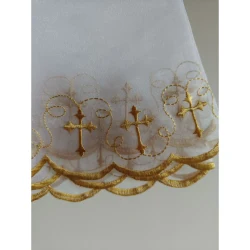
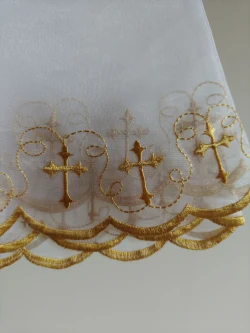
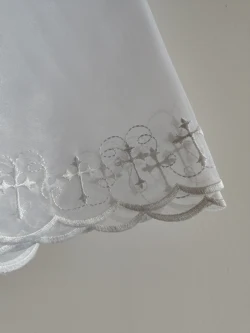
Embroidery adds a sacred motif along the hem. In this category you will find an embroidered cross-shaped finish and a small white flower border. The embroidery is decorative; it does not change the way the veil is used.
Brocade is a heavier, opaque fabric. The golden brocade veil in this category is a ciborium veil with an Easter motif, not a monstrance veil. Brocade is chosen when the veil is meant to be seen as a rich textile rather than a transparent cover.
Colors and the Liturgical Year
The veils in this category are offered in white, gold and silver — the colors most often used for exposition and Benediction. White and gold are especially associated with Christmas, Easter and feasts of the Lord; silver is a sober alternative for solemn celebrations.
Other liturgical colors are used through the year: red for Pentecost, Good Friday and martyrs; green for Ordinary Time; violet for Advent and Lent; rose for Gaudete and Laetare Sunday; black for Requiem Masses where permitted. If you need a colored veil, contact us and we will confirm what is available.
What the Monstrance Veil Symbolizes
The veil hides the monstrance from view and, in the traditional reading, recalls the shroud that covered the body of Christ. It also expresses reverence: the Blessed Sacrament is covered when it is not exposed, and the veil is removed when the faithful are invited to adore.
The veil is not a magical object and it does not add anything to the sacrament. It is a liturgical textile that helps the community treat the Blessed Sacrament with care. For the wider symbolism of the monstrance, see What Is a Monstrance and How Is It Used in Eucharistic Adoration?.
How to Place and Remove a Monstrance Veil
- Place the monstrance on a stable surface or in the tabernacle niche.
- Open the veil and find the center of the top edge.
- Lower the center over the top of the sunburst, then let the sides fall evenly.
- Adjust the hem so that the veil covers the stem and the base without pulling.
- Before exposition, lift the veil from the top and fold it outward, away from the monstrance.
For a large veil, two people make the task easier: one holds the top, the other guides the hem. Avoid touching the host or the inside of the lunette with bare hands.
Care: Folding, Ironing, and Storage
Tulle and embroidery need gentle handling. Shake out the veil after use, fold it loosely and store it flat or rolled in a clean cotton bag. Avoid plastic bags, which can trap moisture.
If the veil needs washing, hand-wash it in cool water with a mild detergent, rinse well and do not wring. Roll it in a towel to remove excess water and dry it flat, away from direct sunlight. Press on low heat through a clean cloth; never iron directly over embroidery or metallic trim.
Store the veil away from incense smoke and direct light, which can yellow white fabrics over time.
Monstrance Veil Prices
Prices depend on the length, the material and the embroidery. Current prices in this category:
| Veil | Length | Price |
|---|---|---|
| Monstrance Veil 90 cm | 90 cm / 35.4 in | $28 |
| Monstrance Veil 100 cm, embroidered cross | 100 cm / 39.4 in | $45 |
| Monstrance Veil 120 cm, tulle | 120 cm / 47.2 in | $34 |
| Monstrance Veil 120 cm, embroidered cross | 120 cm / 47.2 in | $38 |
| Monstrance Veil 120 cm, white flowers | 120 cm / 47.2 in | $23 |
| Monstrance Veil 140 cm | 140 cm / 55.1 in | $37 |
| Ciborium Veil, Easter motif, golden brocade | — | $68 |
Prices are shown at the time of publication and may change. For the current price and availability, open the product page.
How to Choose a Monstrance Veil
- Measure first. Height of the monstrance plus 10–20 cm of drape gives the minimum length.
- Choose the material for the look. Tulle keeps the monstrance visible; embroidery adds a motif; brocade is for a heavier, opaque cover.
- Match the color to the occasion. White and gold for solemn feasts; silver for a quieter look.
- Check the embroidery. A cross border is the classic choice; white flowers suit weddings and Marian feasts.
- Plan the storage. A long veil needs a clean, flat storage space and gentle folding.
If you are choosing a monstrance as well, see How to Choose a Monstrance for Your Church or Chapel and our monstrances. For the cost of the vessel itself, see How Much Does a Monstrance Cost?.
Frequently Asked Questions
What is the difference between a monstrance veil and a humeral veil?
A monstrance veil is draped over the monstrance. A humeral veil is worn over the priest's or deacon's shoulders during Benediction and processions. The monstrance veil is not worn by the minister, and the humeral veil is not placed on the vessel.
What size monstrance veil do I need?
Measure the monstrance from the base to the top of the sunburst and add 10–20 cm for the drape. A 90 cm veil suits a small monstrance, 120 cm is the standard parish length, and 140 cm is for large monstrances above about 85 cm.
What material is a monstrance veil made of?
Most monstrance veils are made of tulle, a light and transparent fabric that lets the monstrance remain visible. Some have an embroidered hem, and heavier veils can be made of brocade. The veils in this category are tulle or embroidered tulle.
What color monstrance veil should I use?
White and gold are the most common colors for exposition and Benediction. Silver is a sober alternative. Red, green, violet, rose and black follow the liturgical year, but the current selection in this category is white, gold and silver.
How do you put a veil on a monstrance?
Find the center of the top edge, lower it over the top of the sunburst, and let the sides fall evenly. Adjust the hem so the veil covers the stem and base without pulling. Before exposition, lift the veil from the top and fold it away from the monstrance.
Can a monstrance veil be used at home?
Yes. A small monstrance and a 90 cm veil are often used in a home oratory. The veil should be kept clean and stored separately from other textiles. Follow the guidance of your parish or diocese for exposition outside a church.
How do you clean and iron a monstrance veil?
Hand-wash in cool water with a mild detergent, rinse well and do not wring. Roll the veil in a towel, dry it flat away from direct sunlight, and press on low heat through a clean cloth. Never iron directly over embroidery or metallic trim.
How much does a monstrance veil cost?
In this category, monstrance veils range from $23 to $45, depending on the length and embroidery. The golden brocade ciborium veil is $68. Prices and availability are shown on each product page.
Is a monstrance veil the same as a monstrance cover?
Not exactly. A monstrance cover can be a fabric veil or a rigid travel case. A monstrance veil is the fabric cover that is draped over the monstrance. A tabor is the stand on which the monstrance is placed, not a cover.
Do you need a veil for Eucharistic adoration?
A veil is not required for adoration. It is a traditional way to cover the monstrance when the Blessed Sacrament is not exposed, and to protect the vessel during processions. The veil is removed for exposition and Benediction.
Can a deacon or a layperson place the monstrance veil?
The veil is a textile, not a sacred vessel, so placing it does not require ordination. In practice, the celebrant, deacon or sacristan usually does it. Follow local custom and the guidance of your diocese.
What is the difference between a ciborium veil and a monstrance veil?
A ciborium veil covers the ciborium, the vessel that holds the hosts. A monstrance veil covers the monstrance, the vessel used to expose the host. They differ in shape and size; see our ciborium veils for the other type.
How do you store a monstrance veil?
Fold the veil loosely or roll it, and store it flat in a clean cotton bag. Avoid plastic, direct sunlight and incense smoke. A padded hanger or a shallow box works well for long veils.
Do monstrance veils come in different lengths?
Yes. This category includes 90, 100, 120 and 140 cm veils. The right length depends on the height of the monstrance and the amount of drape you want.
Related Reading
Continue with Benediction Vestments: Cope, Humeral Veil, and What Else You Need, Benediction of the Blessed Sacrament: A Step-by-Step Guide, and our humeral veils. For the vessels themselves, see monstrances.
Related: For a smaller exposition vessel, see our custodias (liturgical custody).
