


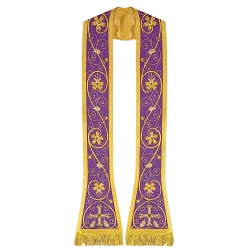
What Is a Roman Stole?
A Roman stole is a liturgical vestment in the Roman (Latin) tradition: a narrow band of coloured cloth worn around the back of the neck, with the two ends hanging straight down in front. The Roman cut is deliberately slim and tailored, unlike the wider Gothic stole. A Catholic priest wears it for Mass and for the sacraments, always in the liturgical colour appointed for the day. In the Roman Rite the stole is one of the vestments that marks the priest's office; a deacon wears the same vestment diagonally across the body, from one shoulder to the opposite hip.
The Roman stole is also called the Latin stole, the Roman priest stole, or simply the priest's stole. Its shape follows the classic Roman pattern: a straight drop, a clean shoulder line, and a narrow width that keeps the vestment close to the body during processions, preaching and the Eucharistic liturgy. The stole is not a decorative scarf; it is the vestment of ordination and of sacramental ministry.
Roman vs Gothic Stole: The Difference
The simplest difference is width and drape. The Roman stole is narrower and straighter; the Gothic stole is broader and hangs with more fullness. Neither is more correct than the other — both are legitimate Western forms — but they suit different vestment sets and different visual traditions. A Roman stole looks best with a Roman-pattern chasuble; a Gothic stole is the natural match for a fuller Gothic set.
| Feature | Roman stole | Gothic stole |
|---|---|---|
| Width | Narrow — 24 cm / 9.44 in on the standard Roman-pattern models | Usually wider, with a fuller fall of fabric |
| Shape | Straight, tailored, close to the body | Broader and softer, with more volume |
| Drape | Clean vertical line; minimal swing | Fuller drape; more movement when walking |
| Typical pairing | Roman-pattern chasubles and tailored sets | Gothic chasubles and fuller ceremonial sets |
| Embroidery | Cross motifs in gold thread; restrained ornament | Often larger motifs, orphreys and decorative bands |
If your parish uses Roman-pattern chasubles, a Roman stole keeps the set visually consistent. If you serve in a church with Gothic vestments, a Gothic stole will match the fuller line. Our Roman chasubles and embroidered chasubles pages show both directions.
Design Features of Our Roman Stoles
- Narrow, straight Roman cut with a clean shoulder line
- Embroidered cross motifs in golden metallic thread
- Most models finished with fringe at the ends — check each listing
- Five liturgical colours: Purple, Red, White, Cream and Green
- Ten models, from the $111 purple stole to the $463.83 jacquard and gemstone model
- Adjustments available on request for selected models
The collection is intentionally practical. The standard Roman-pattern stoles are made for regular parish use, while the premium purple model is a ceremonial piece with jacquard fabric, elaborate gold-thread embroidery and hand-set gemstones. That range lets a parish choose an everyday stole and a separate set for solemn feasts without changing the visual language of the vestments.
Materials and Embroidery
Most Roman stoles in this collection are made from a high-quality plain liturgical fabric chosen for durability. It is stain- and crease-resistant, and it can be washed and ironed, which matters for a vestment worn week after week. The cross motif is embroidered in a golden metallic thread; the thread and fabric are selected so the embroidery keeps its shape after ordinary cleaning. The result is a stole that looks crisp at the ambo and still survives the sacristy routine.
The premium model is different by design: a soft jacquard fabric with a subtle floral pattern, elaborate gold-thread embroidery, hand-set gemstones and shimmering jacquard trimmings. It is intended for solemn celebrations rather than everyday parish use. Its dimensions are shown in the product photograph, because the cut and drape differ from the standard Roman-pattern models. If you need a specific measurement before ordering, contact us and we will confirm it.
Size and Fit
The standard Roman-pattern stoles measure 128 cm (50.39 in) long, including the fringe, and 24 cm (9.44 in) wide. The narrow width is the defining feature of the Roman cut: it sits neatly on the shoulders and stays close to the body. The concelebration models and the premium jacquard model may differ; the individual product listing or photograph gives the exact measurements. Adjustments can be made on request — contact us before ordering if you need a specific length for a taller or shorter priest.
A stole should fall comfortably below the waist without catching on the chasuble. If you are choosing between two lengths, measure an existing stole from the back of the neck to the end of the fringe and compare that figure with the listing. The 128 cm measurement is taken with the fringe included, so it reflects the full visible drop.
Liturgical Colours and Seasons
Roman stoles are worn in the colour appointed for the celebration. This collection covers the five colours a parish uses most often:
| Colour | When it is worn | Meaning |
|---|---|---|
| Purple | Advent, Lent and Reconciliation | Preparation, penance and waiting |
| Red | Pentecost, Good Friday, martyrs and Confirmation | The Holy Spirit, martyrdom and zeal |
| White | Christmas, Easter, feasts of the Lord and Our Lady | Joy, purity and glory |
| Cream | Weddings, funerals and flexible solemn occasions | Warmth, dignity and a softer alternative to white |
| Green | Ordinary Time | Hope, growth and faithful discipleship |
For a fuller explanation of the calendar, see our guide Priest Stole Colours and the Liturgical Season. If you need a stole for a particular feast, the colour should match the chasuble and the other vestments of the set. A second colour is often the most useful purchase for a parish that already owns the basics.
Who Wears a Roman Stole
A Catholic priest wears the stole around the neck, over both shoulders, with the ends hanging down in front. He wears it for Mass, baptisms, confession, anointing of the sick and other sacramental celebrations. A deacon wears the stole across the body, over the left shoulder and across the chest, and the dalmatic is worn over it. A bishop may wear a stole under the chasuble as well. The stole is a sign of the office and of the authority to minister in the Church; it is not a decorative scarf.
Because the stole belongs to the ordained ministry, it is also a personal vestment. Priests often own several stoles in different colours and keep a favourite set for retreats, pilgrimages and parish missions. For the deacon's vesting pattern, see our deacon stoles and the guide How to Wear a Deacon Stole.
How to Choose a Roman Stole
Start with the colour you need most often, then decide between the standard Roman-pattern models and the premium ceremonial piece. If the stole is for regular parish use, the plain fabric models at $111–$145 are the practical choice: they are washable, crease-resistant and available in all five colours. If it is for a solemn feast, a jubilee or a gift, the jacquard and gemstone model is the ceremonial option.
Check the length against a stole the priest already uses, and consider the chasuble style. A Roman stole is the natural match for a Roman-pattern chasuble; a Gothic stole suits a fuller Gothic set. For a gift, the most useful choices are a colour the priest does not yet own, or a concelebration stole for large liturgies. Ordination, first Mass, priesthood jubilee and anniversary are the classic occasions, and a stole is a personal gift that is actually used week after week.
Care and Storage
Follow the care instructions on each listing. Where the description states it, the standard stoles can be washed and ironed; press on the reverse with a cloth between the iron and the embroidery. Store the Roman stole flat or rolled to avoid creasing, and hang heavier vestments on a wide vestment hanger so the shoulder line keeps its shape. Keep the stole away from damp sacristy walls and strong sunlight, which can fade the fabric.
For travel, roll the stole loosely around a soft core rather than folding it sharply. Gold-thread embroidery can catch on rough surfaces, so keep the ends separate from hooks and metal hangers. If the stole needs a deeper clean, follow the care label or ask a specialist vestment cleaner rather than risk the metallic thread.
Price and Ordering
The collection includes 10 Roman stoles. The entry model is $111, the standard Roman-pattern stoles in five colours are $121–$131, the concelebration stoles are $145–$148, and the premium jacquard and gemstone model is $463.83. All prices are in USD. Most items are in stock and ship from our workshop in Poland; made-to-order items take additional time. See shipping information and returns policy for details.
If you are ordering for a parish, a matching set in several colours keeps the vestment cupboard consistent. If you are buying a single stole as a gift, choose the colour that matches the priest's most frequent chasuble and keep the packaging for an easy return. For a priest's anniversary, a stole in a colour he uses often is a practical choice.
Frequently Asked Questions
What Is a Priest's Stole Called?
It is called a stole (in Latin, stola). In the Catholic Church it is the liturgical vestment worn around the neck by priests and deacons; in the Roman Rite it is often called the Roman stole or Roman priest stole.
What Is a Stole in the Catholic Church?
A stole is a band of coloured cloth worn around the back of the neck, with the two ends hanging down in front. Priests wear it over both shoulders for Mass and the sacraments; deacons wear it across the body. It is almost always decorated with crosses.
Do Catholic Priests Wear Stoles?
Yes. The stole is one of the vestments a priest wears for Mass and for the sacraments such as baptism, confession and the anointing of the sick. A deacon wears the same vestment in a different position, across the body.
What Is the Difference Between a Roman and a Gothic Stole?
The Roman stole is narrower and straighter, while the Gothic stole is broader and hangs fuller. The Roman cut is the traditional tailored style; the Gothic cut is the fuller, more voluminous style. Both are legitimate Western forms.
How Long Is a Roman Stole?
The standard Roman-pattern stoles measure 128 cm (50.39 in) in length including the fringe and 24 cm (9.44 in) in width. Concelebration and premium models may differ; the exact measurements are given on each product listing.
What Colours Do Roman Stoles Come In?
This collection offers five colours — Purple, Red, White, Cream and Green — covering the main liturgical seasons. The colour worn on a given day follows the Church's liturgical calendar.
When Is a Roman Stole Worn?
A priest wears the stole for Mass and for the celebration of the sacraments, in the liturgical colour appointed for that day or season. A deacon wears it across the body for his ministry.
How Are These Roman Stoles Made?
Most are made from a high-quality plain liturgical fabric with the cross motif embroidered in a golden metallic thread. The fabric is stain- and crease-resistant and can be washed and ironed. The premium model uses jacquard fabric, gold-thread embroidery and hand-set gemstones.
What Does the Stole Symbolize?
The stole symbolizes the priestly office and the authority to minister the sacraments. It is a sign of service rather than rank, and the cross motifs recall the cross of Christ and the burden of ministry.
How Does a Deacon Wear a Stole?
A deacon wears the stole across the body, over the left shoulder and across the chest to the right hip, with the dalmatic worn over it. A priest wears the stole around the neck with the two ends hanging in front.
What Does the Word "Stole" Mean?
The word comes from the Latin stola, a long garment or robe. In liturgical use it names the band of cloth worn by ordained ministers; it is unrelated to the English word for a stolen item.
Why Does a Priest Wear a Stole?
The stole is the vestment of the priest's office. It is worn for Mass and the sacraments because the ministry is exercised in the person of Christ and in the name of the Church.
What Does a Priest Stole Look Like?
It is a long, narrow band of coloured cloth, usually decorated with crosses and often finished with fringe. A Roman stole is narrow and straight; a Gothic stole is wider and fuller.
Related: explore the wider embroidered liturgical stoles, deacon stoles, Marian stoles, stoles with saints, wedding stoles, Christmas stoles, Easter stoles, Roman chasubles, copes, dalmatics and vestment hangers. For the history, see The Evolution of Liturgical Vestments.
