
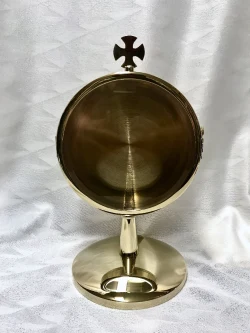
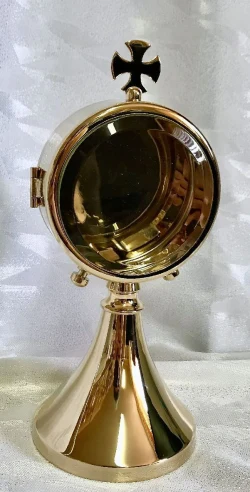
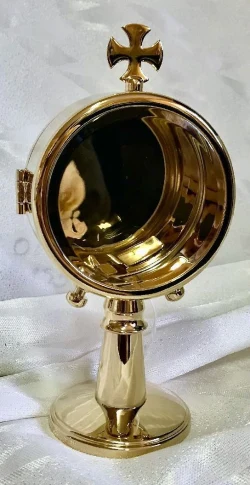
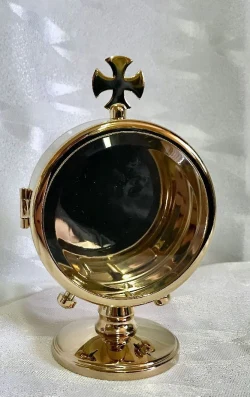
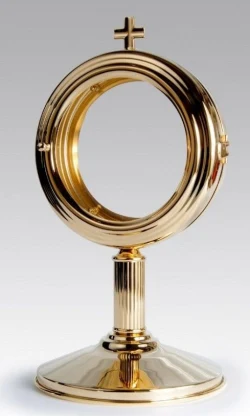
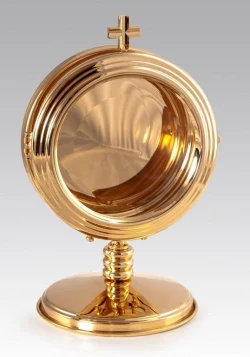


Liturgical Custody: Definition
A liturgical custody — also called a custodia or ostensorium — is the sacred vessel that holds the consecrated host in a lunette so it can be seen during Eucharistic adoration, Benediction, and processions such as Corpus Christi. The host is placed in the lunette (also called the luna), a small metal holder with glass panes, and the custodia keeps it upright and visible while protecting it.
In English liturgical writing, “custody” is used in two closely related ways. Many sources treat custodia as a synonym for monstrance; others use it for the receptacle that holds the host inside the monstrance. Our custodias are complete exposition vessels: a stand, a glass capsule, and a lunette or adjustable guide. They are not ciboria. A ciborium is the lidded vessel used to reserve hosts in the tabernacle and to distribute Communion; a custody is made for showing the Blessed Sacrament, not for storing a large number of hosts.
Every custodia in this collection is made of gold-plated brass and stands between 11 cm and 40 cm high. The glass capsule diameter is listed for each piece (8 cm, 9 cm, or 16 cm), and the large-host models accept a correspondingly larger host. If you are choosing for a parish, start with the host diameter and the setting — side chapel, main sanctuary, or outdoor procession — then choose the height and ornament.
Custodia vs Monstrance vs Ciborium
The three vessels are easy to confuse because they all hold the Eucharist, but they do different jobs. The table below summarizes the difference; the sections that follow explain how to choose.
| Vessel | Purpose | Where it is used | Host visible? | Typical size |
|---|---|---|---|---|
| Custodia / ostensorium | Expose the host for adoration, Benediction, and processions | Altar, throne, tabor, procession | Yes — through glass and lunette | 11–40 cm in this collection |
| Monstrance | Large exposition vessel, often processional | Main sanctuary, Corpus Christi procession | Yes | Often 40–100 cm or more |
| Ciborium | Reserve hosts in the tabernacle; distribute Communion | Altar, tabernacle | No — lidded | Usually 15–30 cm |
| Pyx | Carry Communion to the sick and homebound | Outside the church | No — closed | Small, pocket-sized |
If you need a large processional piece for the main sanctuary, see our monstrances and ostensoria. If you need to reserve hosts, choose a ciborium. If you need to carry Communion to the sick, a pyx is the correct vessel. A custody sits between the ciborium and the large monstrance: it is an exposition vessel, often smaller and easier to place on a side altar or throne.
Types of Custodia
Our 14 custodias fall into four practical groups, with a range of styles within each. The right choice depends on the size of the host, the size of the sanctuary, and whether the vessel will stay on an altar or be carried.
Mini custodias (11–18 cm)
Mini custodias are designed for small chapels, side altars, home oratories, and private exposition. They use an 8–9 cm glass capsule and are light enough to move easily. Examples include the 11 cm mini gilded custody, the 18 cm mini gilded custody, and the baroque mini custody.
Large display custodias (25–40 cm)
Large display custodias use a 16 cm glass capsule and a taller stand, so the host is clearly visible from a distance. They are appropriate for parish churches, adoration chapels, and Benediction. Examples include the 25 cm large-diameter custody, the 40 cm tall custody, and the 40 cm custody with hexagonal base.
Large-host custodias
Large-host custodias have an adjustable guide or a wider lunette for a larger host. The 36 cm large-host custody is decorated with rubies and an IHS door; the 21 cm custodia accepts hosts up to 7 cm. If your parish uses a large host for exposition, start with these models and confirm the host diameter before ordering.
Closed and carrying custodias
Some custodias can be closed for transport, which is useful when the Blessed Sacrament is carried to the sick or moved between the church and a chapel. The 21 cm custodia is shown both closed and open. If you need a vessel specifically for carrying Communion, a pyx is usually the safer choice; a closed custody is larger and more ceremonial.
Styles and ornament
Within these groups you can choose baroque, rococo, or simple round bases; a window or an open capsule; the Lamb motif; the Evangelists on the foot; or an IHS door. Ornament should serve the liturgy, not distract from the Blessed Sacrament. For a parish that already has baroque candlesticks and a ciborium, a matching baroque or rococo custodia gives visual continuity.
The Lunette Explained
The lunette — also called the luna — is the metal holder that grips the host so it stands upright inside the custodia. It usually has two glass panes and a curved or adjustable track. The host is placed between the panes, the lunette is slid into the custodia, and the glass capsule protects the host from dust and touch.
Two measurements matter. The host diameter must fit the lunette, and the glass capsule diameter must be large enough for the lunette and the host. In this collection, the capsule diameters are 8 cm, 9 cm, and 16 cm. The 21 cm custodia accepts a host up to 7 cm; the large-host models are designed for a correspondingly larger host. If you already have a lunette, measure its outer diameter and compare it with the capsule; if you are buying both, choose them together.
The lunette is also the part that receives the most handling. Keep it clean, avoid touching the glass with bare fingers, and store it in a case when not in use. A spare lunette is useful for parishes that expose the Blessed Sacrament frequently.
How to Choose a Custodia for a Large Host
For a large host, work through these six checks before you choose a model.
- Host diameter. Measure the host you will use. The 21 cm custodia accepts up to 7 cm; the 36 cm large-host custody is designed for a larger host. Do not assume that a taller custodia automatically has a wider lunette.
- Lunette and guide. Look for an adjustable guide or a lunette with a track. This keeps the host upright and centered, especially when the custodia is carried.
- Capsule size. A 16 cm glass capsule gives more room around a large host. The 8–9 cm capsules are intended for smaller hosts and mini custodias.
- Height and visibility. A 36–40 cm custodia is easier to see from the back of a church than an 18 cm mini custodia. Check the sightline from the nave and the height of the throne or altar.
- Stability and weight. A tall custodia needs a broad base. The 40 cm model with a hexagonal base is more stable than a narrow round base. Consider who will carry it and whether it will be placed on a tabor.
- Procession or static use. If the custodia will be carried in a Corpus Christi procession, choose a secure lunette, a stable base, and a size that matches your monstrance throne (tabor). If it will stay on the altar, a smaller model may be easier to handle.
For a large-host parish, the 36 cm large-host custody is the most specialized piece in the collection. For a smaller large host, the 21 cm custodia with adjustable guide is the practical choice. If you need a taller silhouette, compare the 40 cm tall custody and the 40 cm hexagonal-base custody.
Custodia for Corpus Christi Processions and Benediction
Corpus Christi is the feast that gave the monstrance and the custodia their public role. The Blessed Sacrament is exposed in the lunette and carried in procession, often under a canopy, with candles and incense. For Benediction, the priest uses the same vessel to bless the people with the host.
For a procession, the vessel must be stable, the lunette secure, and the height appropriate for the carrier and the canopy. A 40 cm custodia is easier to see than an 18 cm mini custodia, but it is also heavier. Check the weight, the base, and the grip. If the custodia will be placed on a tabor between stations, choose a tabor with a compatible top and a secure fit. A monstrance veil is used to cover the vessel when the Blessed Sacrament is not exposed; it is not the same as the lunette or the glass capsule.
For outdoor use, avoid leaving the custodia in direct sun or damp air for long periods. Gold-plated brass is durable, but the glass and the lunette should be checked before and after the procession. Carry the vessel with both hands, or use a tray, and have a secure place to set it down during stops.
Materials, Finishes, and Symbolism
Gold-plated brass is the standard material for this collection. It is durable, repairable, and visually appropriate for sacred vessels. The gold plating gives a warm, reflective surface; it is not solid gold, and it can be renewed by a specialist if it wears. One model, the Custody with the Lamb, includes a silver element; the 36 cm large-host custody is decorated with rubies and a silver-plated IHS door.
The ornament is not decoration for its own sake. The Lamb recalls the sacrificial Lamb of God; the Evangelists on the foot connect the Eucharist to the proclamation of the Gospel; the IHS monogram is the name of Jesus; the rays around the capsule evoke the light of the Transfiguration and the risen Christ. Choose the symbolism that fits your church, but keep the Blessed Sacrament itself as the visual center.
We do not claim solid silver, custom engraving, or a particular country of manufacture unless the product description says so. If you need a specific finish or inscription, contact us before ordering so we can confirm what is possible.
How to Care for a Custodia
Treat the custodia as a sacred vessel, not as ordinary metalware. Handle it with clean hands, and avoid touching the glass or the lunette with bare fingers. After use, remove the lunette, check that the host has been consumed or reserved according to liturgical norms, and wipe the glass with a soft lens cloth. Do not use abrasive polishes or scouring pads on gold plate.
Store the custodia in a dry place, ideally in a case or a lined cabinet. Keep the lunette in its own case so the glass does not rub against the capsule. If the gold plating wears thin, have it restored by a specialist who works with sacred vessels; do not attempt a DIY re-plating. Before the next use, check that the lunette slides smoothly and that the glass is secure.
For transport, close the custodia if the model allows it, or use a padded case. A guide to storing sacred vessels covers ciboria, chalices, and monstrances as well; the same principles apply to custodias.
Custodia Price Guide
The 14 custodias in this collection range from $242 to $1,553, with a median price of $659.50. Seven of the 14 are under $700. Prices depend on size, capsule diameter, ornament, and the complexity of the casting. The table below groups the current models by type; the exact price is shown on each product page. Prices are current as of November 2026.
| Type | Height | Capsule | Price range | Best for |
|---|---|---|---|---|
| Mini custodias | 11–18 cm | 8–9 cm | $242–$694 | Side chapels, home oratories, private exposition |
| Large display custodias | 25–40 cm | 16 cm | $564–$782 | Parish churches, adoration chapels, Benediction |
| Large-host custodias | 21–36 cm | up to 16 cm | $674–$1,089 | Large hosts, processions, main sanctuary |
| Ornate / Evangelists | 29 cm | — | $1,553 | Formal sanctuary, matching ornate vessels |
Shipping is free on orders over $100. If you are comparing a custody with a monstrance, read our monstrance cost guide; the price logic is similar, but a large processional monstrance is usually more expensive than a chapel custody.
Frequently Asked Questions About Custodias
Q: What is a liturgical custody?
A: A liturgical custody — also called a custodia or ostensorium — is a sacred vessel that holds the consecrated host in a lunette so it can be seen during Eucharistic adoration, Benediction, and processions. It is an exposition vessel, not a storage vessel.
Q: Is a custody the same as a monstrance?
A: The terms overlap. Many sources treat custodia as a synonym for monstrance; others use custodia for the receptacle that holds the host inside the monstrance. In practice, a custody is often a smaller exposition vessel, while a monstrance is the large, often processional piece. Both show the Blessed Sacrament.
Q: What is the difference between a custody and a ciborium?
A: A ciborium is a lidded vessel used to reserve hosts in the tabernacle and to distribute Communion. A custody is made for exposition: the host is visible in a lunette behind glass. If you need to store hosts, choose a ciborium; if you need to show the host, choose a custody.
Q: What is a lunette, and why does it matter?
A: The lunette, or luna, is the metal holder that grips the host upright inside the custody. It usually has two glass panes and an adjustable track. The host diameter and the glass capsule diameter must match the lunette; that is why we list both measurements.
Q: What size host does a custody hold?
A: It depends on the model. The 21 cm custodia accepts a host up to 7 cm; the mini custodias use an 8–9 cm capsule and are intended for smaller hosts; the 16 cm capsule models and the 36 cm large-host custody are designed for larger hosts. Measure your host before ordering.
Q: How do I choose a custody for a large host?
A: Start with the host diameter, then check the lunette or adjustable guide, the capsule diameter, the height, the stability of the base, and whether the vessel will be carried in procession. The 36 cm large-host custody is the most specialized model; the 21 cm custodia with adjustable guide is the compact option.
Q: Can a custody be used for Benediction?
A: Yes. Benediction uses the Blessed Sacrament exposed in the lunette. A custody with a secure lunette, a stable base, and a height that suits the altar or throne is appropriate. The priest blesses the people with the host in the vessel.
Q: Can a custody be used in a Corpus Christi procession?
A: Yes, provided the vessel is stable and the lunette is secure. A larger custody or monstrance is usually chosen for a public procession; a mini custody is better suited to a chapel or home oratory. Check the weight and the fit on the tabor or carrying arrangement.
Q: What is a closed custody?
A: A closed custody can be shut for transport, protecting the host and the lunette. The 21 cm custodia is shown both closed and open. For carrying Communion to the sick, a pyx is usually the simpler and safer choice; a closed custody is larger and more ceremonial.
Q: What materials are custodias made of?
A: The custodias in this collection are made of gold-plated brass. One model includes a silver element, and the 36 cm large-host custody is decorated with rubies and a silver-plated IHS door. We do not claim solid silver or custom engraving unless the product description says so.
Q: How do I clean and store a custody?
A: Handle it with clean hands, avoid touching the glass, wipe the glass with a soft lens cloth, and store the vessel and lunette in a dry, padded place. Do not use abrasive polishes on gold plate; have worn plating restored by a specialist.
Q: Does a custody need to be blessed?
A: Yes. Like other sacred vessels used for the Eucharist, a custody should be blessed by a priest before liturgical use. The blessing sets it apart for sacred service.
Q: How much does a custody cost?
A: In this collection, custodias range from $242 to $1,553, with a median of $659.50. Mini custodias start at $242; large display custodias are $564–$782; the large-host and ornate models are $674–$1,553. Shipping is free over $100.
Q: How many hosts can a custody hold?
A: A custody is not rated by host capacity like a ciborium. It holds one host in the lunette for exposition. If you need to reserve many hosts for Communion or adoration, choose a ciborium; if you need to expose one host, choose a custody.
Q: Can I use a custody at home?
A: A small custody can be used for private exposition in a home oratory, with proper reverence and according to local norms. Consult your pastor about the place, the reservation of the Blessed Sacrament, and the blessing of the vessel.
Related Reading
Continue with our guides to what a monstrance is, monstrance vs tabernacle vs ciborium, how to choose a monstrance, and how much a monstrance costs. For the textiles that complete the set, see our monstrance veils and ciborium veils.
