


What Is a Red Chalice Pall?
A red chalice pall is a stiffened square of fabric placed over the chalice during Mass celebrated in red vestments. It is the chalice cover that protects the Precious Blood from dust and insects, and it belongs to the family of chalice linens together with the corporal, the purificator and the chalice veil. Our red collection includes 20 palls in 16 × 16 cm (6.3 in), 18 × 18 cm (7.1 in) and 20 × 20 cm (7.9 in), made of cotton, jacquard and velvet, with prices from $16.00 to $28.50. Each pall is stiffened with an insert, so it lies flat on the rim of the chalice and stays in place during the Eucharistic Prayer.
The red pall is a seasonal piece rather than an everyday white linen. It is chosen when the priest wears red, and it brings the colour of the day onto the altar itself. If you are looking for the full range of colours, see the chalice pall collection; if you need the other linens that dress the chalice, see the chalice linen sets.
The Liturgical Meaning of Red
Red is the colour of blood and of fire. In the liturgy it points first to the Passion of the Lord — Palm Sunday and Good Friday — and then to the Holy Spirit, whose descent on the apostles is celebrated at Pentecost. Red is also worn on the feasts of apostles and evangelists and on the celebrations of martyrs, who gave their blood for the faith. A red chalice pall carries that meaning onto the altar, where it rests above the Precious Blood.
The General Instruction of the Roman Missal lists the occasions for red in no. 346: Palm Sunday of the Lord's Passion, Good Friday, Pentecost Sunday, celebrations of the Lord's Passion, the feasts of apostles and evangelists, and the memorials of martyrs. A sacristy that keeps palls in several colours will therefore use the red one more often than a single feast might suggest — especially in a parish dedicated to a martyr or an apostle.
When Is a Red Chalice Pall Used?
A red pall is used whenever Mass is celebrated in red vestments. The most familiar occasions are Palm Sunday, Good Friday and Pentecost Sunday. It is also the right colour for votive Masses of the Holy Spirit, celebrations of the Lord's Passion, the feasts of the Apostles and Evangelists, and the memorials of martyrs. In parishes that keep palls in several colours, the red pall is the one that comes out for Pentecost and for the feasts of the parish's patron martyrs.
Because red is used at both the beginning and the end of Holy Week, a red pall is often bought together with a white pall and a violet pall. A complete set lets the sacristy change the altar colour without searching for a matching piece at the last minute. The white, violet, green and black palls follow the same construction, so the altar keeps a consistent look through the year.
Pall Cover and Insert: How a Chalice Pall Is Made
The word cover describes the fabric part of the pall; the insert is the stiffener inside it. Traditionally the insert was a piece of stiffened card, and today it is often a thin plastic or plexiglass panel. The cover is wrapped around the insert and finished with embroidery, a border or lace edging. The insert is what makes the pall lie flat on the chalice and keeps the fabric from dipping into the Precious Blood.
Most of our jacquard and velvet palls have a removable panel that slides out from the bottom. That detail matters for care: once the insert is removed, the fabric can be washed and ironed without warping the stiffener. The cotton palls are also stiffened and finished with a delicate lace edging. When you receive a pall, check the opening at the bottom before washing — if there is a panel inside, take it out first.
Red Chalice Pall Sizes: 16 × 16, 18 × 18 and 20 × 20 cm
Size is the first practical decision. The pall must cover the outer rim of the chalice completely and lie flat, with no overhang that could catch on the veil or on the priest's hands. Our red collection is made in three sizes: 16 × 16 cm (6.3 × 6.3 in), 18 × 18 cm (7.1 × 7.1 in) and 20 × 20 cm (7.9 × 7.9 in). The 18 cm size is the most common for parish chalices; the 16 cm size suits compact chalices and travel sets; the 20 cm size is for wide bowls and solemn vessels.
| Size | Inches | Palls in this collection | Best for |
|---|---|---|---|
| 16 × 16 cm | 6.3 × 6.3 in | 7 | Standard chalices, compact travel sets, smaller sacristies |
| 18 × 18 cm | 7.1 × 7.1 in | 11 | Most parish chalices, wide rims, everyday use |
| 20 × 20 cm | 7.9 × 7.9 in | 2 | Large or wide chalices, solemn sets, full coverage |
To choose, measure the outer rim of your chalice with a ruler. If the rim is close to the edge of a 16 cm pall, move up to 18 cm. If the chalice has a wide bowl, a decorative rim or a large paten, choose 18 cm or 20 cm. When in doubt, a slightly larger pall is safer than a smaller one: a pall that does not cover the opening has no purpose. In inches, the three sizes are 6.3 × 6.3 inch, 7.1 × 7.1 inch and 7.9 × 7.9 inch, so a listing described as 7 inch is the 18 cm size.
Cotton, Jacquard and Velvet: Materials and Embroidery
The red collection uses three material families. Cotton is the traditional choice: soft, breathable and finished with a delicate lace edging. Jacquard is a woven fabric with a subtle pattern, often finished with a gold brocade border; it is the material of most of the newer designs and is suitable for washing and ironing once the insert is removed. Velvet is the most decorative option, reserved for solemn occasions and enriched with gold embroidery.
| Material | Character | Care |
|---|---|---|
| Cotton (11 palls) | Traditional, soft, lace edging | Hand-wash in lukewarm water, iron while damp |
| Jacquard and patterned fabrics (8 palls) | Woven pattern, gold brocade border, washable and ironable | Remove the insert, wash gently, iron on the reverse |
| Velvet (1 pall) | Deep pile, gold embroidery, most decorative | Spot-clean or hand-wash with care, do not wring |
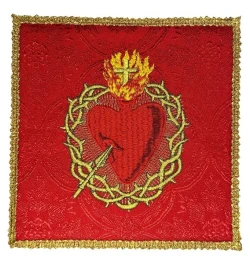
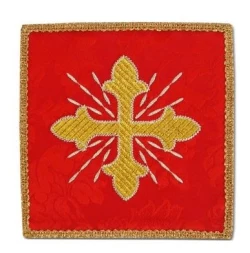
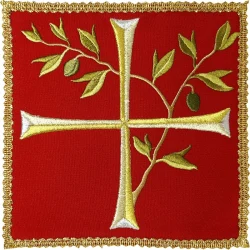
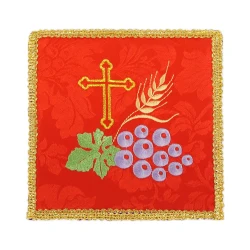
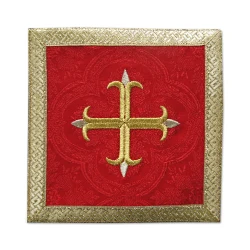
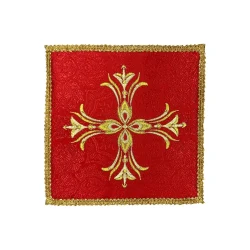
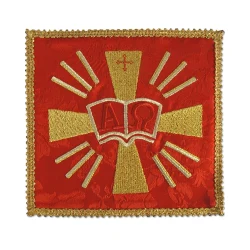
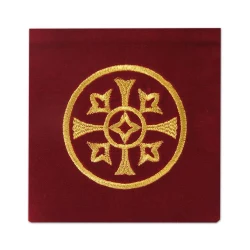
The embroidery is where the tradition lives. Our red palls carry the IHS monogram, plain and decorative crosses, the Fish, the chalice with grapes, the Sacred Heart of Jesus, the Alpha and Omega, the Holy Spirit in the form of a dove, and combinations of cross, wheat and olive branch. The motifs are embroidered with satin and metallic threads, and many designs are finished with a gold brocade border.
How to Choose the Right Red Chalice Pall
Choose the pall the way a sacristan would: start with the chalice, then the season, then the embroidery. Measure the rim, decide whether you need a 16, 18 or 20 cm square, and only then choose the material and motif. A pall that fits well but carries a simple cross is more useful than an elaborate pall that slides off the chalice.
- Fit: the pall must cover the opening completely and lie flat on the rim.
- Season: red for Pentecost, Palm Sunday, Good Friday, apostles and martyrs.
- Material: cotton for a traditional look, jacquard for a patterned surface, velvet for solemn occasions.
- Insert: check whether the stiffener is removable before washing.
- Quantity: at least two palls per altar, so one can be laundered while the other is in use.
- Set: match the pall with a chalice veil, purificator, corporal and burse in the same colour family.
If the parish already owns a red chalice veil and burse, choose a pall with a similar border and thread colour. If you are building a set from scratch, the chalice linen sets bring the pieces together in matching fabric.
Care and Washing of Red Chalice Palls
Care begins with the insert. Remove the stiffening panel from the bottom opening before the cover touches water. Hand-wash the fabric in lukewarm water with a mild detergent, rinse thoroughly, and do not wring or twist. Roll the pall in a clean towel to remove excess water, then iron it on the reverse side while it is still slightly damp. Never use bleach, starch or fabric softener on liturgical linens.
If the pall has touched the Precious Blood, rinse it first in a sacrarium or over a drain that goes into the ground, as the Church asks for linens that have been in contact with the Eucharist. Then wash it as usual. Store the pall flat or rolled, not folded along the embroidery, in a dry sacristy drawer or a linen bag. A pall that is stored flat keeps its shape and its stiffener for longer.
Red Chalice Palls and the Other Chalice Linens
The pall is one piece of a small set of linens that work together at Mass. The corporal is the square linen spread under the vessels; the purificator is the folded cloth used to wipe the chalice after Communion; the chalice veil is the large draped cloth that covers the whole chalice outside the Eucharistic Prayer; and the burse holds the folded corporal. The pall is the stiffened cover that sits directly on the chalice during the Eucharistic Prayer.
| Linen | Purpose | Where it is used |
|---|---|---|
| Chalice pall | Stiffened cover for the chalice | On the chalice during the Eucharistic Prayer |
| Chalice veil | Draped cover for the whole chalice | Over the chalice outside the Eucharistic Prayer |
| Purificator | Wiping cloth | Folded over the chalice, used after Communion |
| Corporal | Square linen for the vessels | Unfolded on the altar under the chalice and paten |
| Burse | Case for the folded corporal | Carried with the chalice veil |
For the adjacent linens, see our ciborium veils and lavabo towels. The guide to the chalice pall explains the history, the names and the differences in more detail.
Red Palls for Pentecost, Palm Sunday and Martyrs' Feasts
Red is the colour that carries the Church through the most intense days of the liturgical year. On Palm Sunday the red vestments and the red pall frame the reading of the Passion. On Good Friday the same colour marks the Lord's death. At Pentecost red turns toward fire and the Holy Spirit, and the red pall sits above the chalice as a sign of the Spirit's descent. The rest of the year, red returns for apostles, evangelists and martyrs.
For a parish that wants a complete seasonal set, pair the red pall with the white, violet, green, black, rose, gold and blue palls. The full collection shows every colour in one place.
Frequently Asked Questions
What Is the Difference Between a Chalice Pall and a Chalice Cover?
A chalice pall and a chalice cover are the same thing: the stiffened square that covers the chalice during Mass. The larger draped cloth that covers the whole chalice outside the Eucharistic Prayer is the chalice veil, not the pall.
What Is Inside a Chalice Pall?
Inside the fabric cover there is a stiffening insert — traditionally stiffened card, today often a thin plastic or plexiglass panel. The insert keeps the pall flat on the rim of the chalice. On most of our jacquard and velvet palls the panel can be removed from the bottom before washing.
What Size Chalice Pall Do I Need?
Measure the outer rim of your chalice. A 16 × 16 cm (6.3 inch) pall suits a standard chalice; 18 × 18 cm (7.1 inch) is the most common size for parish chalices; 20 × 20 cm (7.9 inch) is for wide bowls and large vessels. The pall must cover the opening completely and lie flat.
Which Size Is Right for a Wide Chalice?
Choose 18 × 18 cm or 20 × 20 cm. If the chalice has a wide bowl, a decorative rim or a large paten, size up rather than down. A pall that is slightly too large still covers the opening; one that is too small does not.
Which Material Is Best for a Red Chalice Pall?
Cotton is the traditional choice and has a soft, matte finish. Jacquard is woven with a subtle pattern and is suitable for washing and ironing once the insert is removed. Velvet is the most decorative option and is best reserved for solemn occasions.
Can a Red Chalice Pall Be Washed?
Yes. Remove the stiffening insert first, then hand-wash the cover in lukewarm water with mild detergent. Rinse well, roll in a towel, and iron on the reverse side while slightly damp. Do not bleach, starch or wring the fabric.
How Do I Remove the Insert Before Washing?
Look for an opening at the bottom edge of the pall. Slide the stiffening panel out gently, keeping it flat. Wash the fabric cover, let it dry partially, iron it on the reverse, and put the panel back only when the cover is completely dry.
When Is a Red Chalice Pall Used?
Red is used on Palm Sunday, Good Friday, Pentecost Sunday, celebrations of the Lord's Passion, the feasts of apostles and evangelists, and the memorials of martyrs. A red pall is used whenever Mass is celebrated in red vestments.
Is Red Used at Pentecost?
Yes. Pentecost is one of the principal red days of the liturgical year. Red recalls the fire of the Holy Spirit, and the red chalice pall matches the red vestments worn at the Pentecost Mass.
What Symbols Are Embroidered on Red Chalice Palls?
Our red palls carry the IHS monogram, plain and decorative crosses, the Fish, the chalice with grapes, the Sacred Heart of Jesus, the Alpha and Omega, the Holy Spirit as a dove, and combinations of cross, wheat and olive branch.
How Much Do Red Chalice Palls Cost?
Red chalice palls in this collection range from $16.00 to $28.50. The jacquard cross design starts at $16.00, the cotton palls are $18.00 to $20.00, and the velvet pall with decorative embroidery is $28.50.
Do Red Chalice Palls Come with an Insert?
Every pall is stiffened. The jacquard and velvet listings specify a removable panel at the bottom; the cotton palls are stiffened and finished with lace edging. Check the individual product description for the exact construction.
Are Red Chalice Palls Made in Poland?
Yes. Our red chalice palls are made in Poland by our workshop, with embroidery in satin and metallic threads and gold brocade borders on many designs.
Can I Use a Red Pall with a Chalice Veil and Burse?
Yes. The pall is used together with the chalice veil, purificator, corporal and burse. The veil covers the whole chalice outside the Eucharistic Prayer, while the pall sits directly on the chalice during the Eucharistic Prayer.
Related reading: What Is a Chalice Pall? Meaning, Sizes, and Use at Mass.
