

The Stations of the Cross are a fourteen-step devotion that follows Jesus Christ from his condemnation to his burial. Catholics pray the Stations by moving from one image or plaque to the next, reading Scripture, reflecting on the scene, and praying. The devotion is also called the Way of the Cross, Via Crucis, or the Way of Sorrows.
It is most closely associated with Lent and Good Friday, but it can be prayed at any time. A traditional set has fourteen stations. Many sets add a fifteenth panel showing the Resurrection, turning the devotion toward Easter. This guide explains the stations in order, the difference between fourteen and fifteen stations, how to pray at church or home, and how to choose a set for a parish, chapel, or family.
What Are the Stations of the Cross?
The Stations of the Cross are a series of fourteen images or plaques representing scenes from the Passion of Christ. The faithful move from station to station, usually in numerical order, and pause at each one for prayer and meditation. The devotion is a pilgrimage in miniature: the church or room becomes the road from Jerusalem to Calvary and the tomb.
Each station usually includes a visual scene, a title, and a short reflection. In a parish, the stations are mounted around the walls of the nave or chapel. At home, a smaller set can be placed on a wall or used as a focus for family prayer. The physical movement from one station to the next is part of the devotion; it helps the body follow what the mind is contemplating.
The Stations are not a substitute for the Mass. They are a devotional practice that helps the faithful enter more deeply into the Paschal Mystery. For parishes, they are especially valuable during Lent, when the whole community is preparing for Easter.
The 14 Stations of the Cross in Order
The traditional Franciscan sequence used in most Catholic churches is:
| Station | Scene | What it invites us to contemplate |
|---|---|---|
| 1 | Jesus is condemned to death | Unjust judgment and the beginning of the Passion |
| 2 | Jesus takes up his cross | The willing acceptance of the cross |
| 3 | Jesus falls the first time | Human weakness and the weight of sin |
| 4 | Jesus meets his blessed Mother | The sorrow of Mary and the cost of love |
| 5 | Simon of Cyrene helps Jesus carry the cross | Compassion and the call to help others |
| 6 | Veronica wipes the face of Jesus | Courage, tenderness, and the image of Christ |
| 7 | Jesus falls the second time | Perseverance after failure |
| 8 | Jesus meets the women of Jerusalem | Mourning, repentance, and the suffering of others |
| 9 | Jesus falls the third time | The final exhaustion before Calvary |
| 10 | Jesus is stripped of his garments | Poverty, humiliation, and detachment |
| 11 | Jesus is nailed to the cross | The crucifixion and the offering of his life |
| 12 | Jesus dies on the cross | The death of the Savior and the meaning of sacrifice |
| 13 | Jesus is taken down from the cross | The grief of Mary and the disciples |
| 14 | Jesus is laid in the tomb | The silence of Holy Saturday and the hope of resurrection |
Some parishes use the Scriptural Stations of the Cross, composed by Pope John Paul II in 1991. That version follows a different selection of Gospel scenes. The traditional fourteen stations above remain the most common in churches and the one used by most sets sold for parish use.
Where the Devotion Comes From
The Stations of the Cross grew out of the practice of pilgrims walking the Via Dolorosa in Jerusalem, the traditional route Jesus took from the place of his condemnation to Calvary. When pilgrims could not travel to the Holy Land, churches began to create local representations of the same scenes so that the faithful could follow the Way of the Cross at home.
The number of stations varied over the centuries. By the eighteenth century, the traditional fourteen had become the standard in the Western Church. The devotion spread widely through the Franciscan order, which has long been entrusted with the care of the holy places in Jerusalem. Today the Stations are found in churches, chapels, cemeteries, and homes around the world.
The exact form of the devotion can vary. Some parishes use a booklet with Scripture readings and reflections; others use a simple guide with the traditional prayers. Some include music, silence, or a procession. The common thread is the same: the faithful follow Jesus through his Passion and prepare to celebrate his Resurrection.
14 Stations or 15? The Resurrection Panel
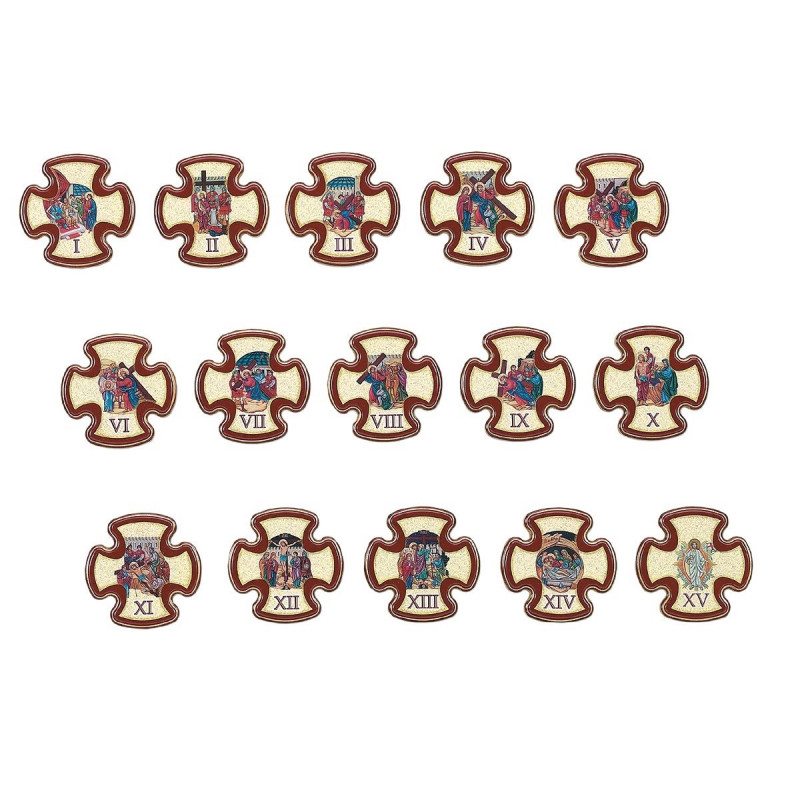
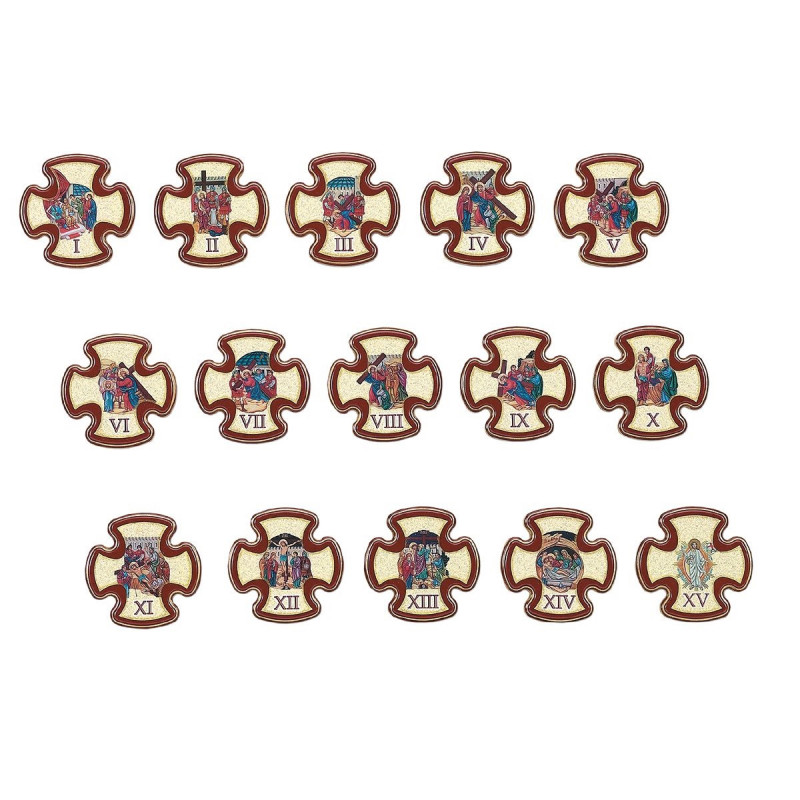
A traditional set ends with the fourteenth station, Jesus being laid in the tomb. A fifteen-piece set adds a fifteenth panel showing the Resurrection. The fifteenth station is not part of the traditional fourteen, but it is widely used because it completes the story and connects Good Friday with Easter Sunday.
The choice between fourteen and fifteen stations is usually a matter of local custom and the space available. A fourteen-station set fits the traditional arrangement around a church nave. A fifteen-piece set gives the devotion a clear Easter ending and is especially suitable for a home, chapel, or a parish that wants to emphasize the Resurrection.
If you already have a traditional fourteen-station arrangement, check whether the fifteenth panel can be displayed separately or omitted without leaving an awkward gap. If you are buying a new set, the five MDF sets in our collection contain fifteen pieces: the fourteen traditional stations plus the Resurrection panel.
How to Pray the Stations at Church
In a parish, the Stations are usually prayed during Lent, often on Friday evenings. The leader may be a priest, deacon, or trained layperson. The basic structure is simple:
- Begin with the Sign of the Cross. The leader introduces the devotion and invites the people to follow Christ.
- Move to each station. At each station, the leader announces the station, reads a short Scripture passage or reflection, and leads a prayer.
- Allow silence. A few moments of silence help the community meditate on the scene.
- Use music if appropriate. A cantor or choir can sing the Stabat Mater or another appropriate hymn between stations.
- End with a prayer at the foot of the cross. The devotion usually concludes with a prayer for the Church, the world, and the faithful departed.
The exact prayers can vary. The most important thing is that the devotion is prayer, not a performance. The leader should speak clearly, keep the pace steady, and allow the community to enter into the scenes.
How to Pray the Stations at Home
You do not need a church to pray the Stations. A small set on a wall, a booklet, or a simple printed guide is enough. At home, the devotion can be adapted to the family:
- Gather before the first station and begin with the Sign of the Cross.
- Read the station title and a short Scripture passage.
- Reflect on one concrete way to follow Christ in daily life.
- Pray the Our Father, Hail Mary, and Glory Be, or use a shorter prayer with children.
- Move to the next station in silence or with a simple hymn.
- End with a prayer of thanksgiving and a moment of silence.
Families with young children may prefer a shorter version with one reflection per station. The goal is not to finish quickly but to help everyone enter into the mystery of the Passion at an age-appropriate level. A small 9.5 × 9.5 cm or 14.5 × 14.5 cm set is practical for a home wall, while a wooden wall cross can be a compact alternative in a small room.
How to Choose Stations for a Parish or Home
The right set depends on the space, the wall, and the way the Stations will be used. For a church, the main questions are size, material, mounting, and the number of stations. For a home, the questions are size, storage, and whether the set will be used for family prayer or simply as a devotional focus.
| Setting | Recommended format | Why |
|---|---|---|
| Church nave | 48 × 34 cm MDF set | Large scenes remain visible from the back of the church |
| Small church or chapel | 32 × 24.5 cm MDF set | Good visibility without overwhelming a smaller wall |
| Home or classroom | 9.5 × 9.5 cm or 14.5 × 14.5 cm set | Compact, easy to arrange, and suitable for family prayer |
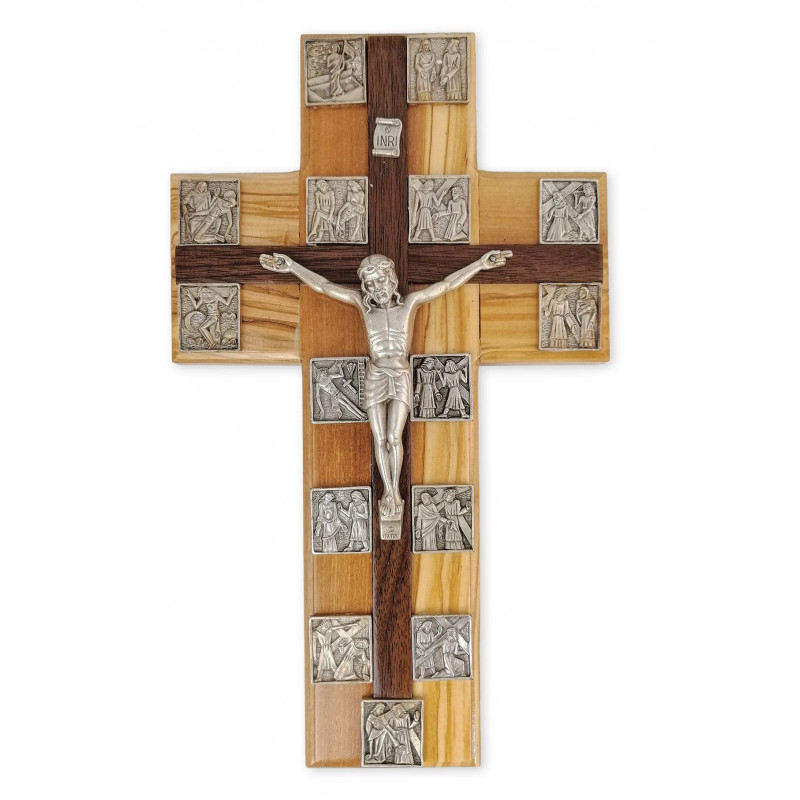
| Small room or sacristy | Italian wooden wall cross | Combines the stations and crucifix in one wall piece |
For a parish, measure the wall before ordering and check visibility from the back of the nave. The 48 × 34 cm panels are the safest choice for a long church wall; the 32 × 24.5 cm panels suit a smaller church or chapel. The wooden crosses are compact and decorative, but they are not a substitute for a full set of separate panels in a large church.
Material also matters. The Italian wooden crosses are made of wood with metal reliefs; the MDF sets are lighter and available in larger panel sizes. The MDF sets are intended for indoor display. If you need Stations for an outdoor garden or cemetery, choose a set made specifically for weather exposure.
You can browse the current Stations of the Cross collection to compare sizes and prices. The collection includes four Italian wooden wall crosses and five fifteen-piece MDF sets. Popular sizes include the 9.5 × 9.5 cm set, the 14.5 × 14.5 cm set, the 32 × 24.5 cm set, the 48 × 34 cm set, and the Italian olive-wood wall cross.
How to Hang and Arrange the Stations
Arrange the stations in numerical order around the walls of the church or room. A common starting point is to place the center of each panel at roughly eye level for a standing adult, then adjust for ceiling height, seating, and architectural features. Keep the spacing consistent so the eye can follow the sequence.
The first station is usually placed on the left side of the nave as you face the altar, and the sequence continues around the walls. The fifteenth panel, where included, follows the fourteenth. Avoid placing a panel where a door, radiator, statue, or light fixture interrupts the sequence. If the wall is irregular, keep the top or bottom line consistent rather than the center line.
Before drilling, check for wiring, pipes, and studs. Use fixings rated for the weight of the panel and the wall material. For a church, ask the sacristan or building committee to approve the layout before installation. For a home, a simple layout on the floor before hanging can save time and avoid unnecessary holes.
How to Care for Wood and MDF Stations
Dust the panels with a soft, dry cloth. For the wooden crosses, a dry cloth is usually enough; the metal reliefs can be dusted with a soft brush. Avoid wet cloths on MDF, because moisture can swell the board and lift the laminate. Do not use abrasive cleaners, solvents, or furniture polish on the printed or laminated surfaces.
Keep the stations away from direct sunlight, radiators, and damp walls. In a church that is heated intermittently, allow the panels to acclimatize before installation. If a panel becomes loose, remove it from the wall and have the fixing checked rather than adding more adhesive.
Stations of the Cross and the Lenten Season
The Stations are one of the most characteristic Lenten devotions because they help the faithful accompany Christ in his Passion. They also prepare the community for the Easter Vigil and the celebration of the Resurrection. A parish that prays the Stations regularly during Lent gives people a stable rhythm of prayer between Ash Wednesday and Holy Week.
For families, the Stations can be a simple way to keep Lent focused on Christ rather than on external practices. A short reflection at each station, a moment of silence, and a prayer for someone who is suffering can be enough. The devotion does not require a large set or a church building; it requires a willingness to follow Christ.
If you are preparing a parish for Lent, you may also find our guides to Ash Wednesday preparation, preparing your church for Lent, and vestment colors for Lent useful.
Frequently Asked Questions
Q: What are the Stations of the Cross?
A: The Stations of the Cross are a fourteen-step devotion that follows Jesus from his condemnation to his burial. The faithful move from station to station, reading Scripture, reflecting on each scene, and praying.
Q: How many Stations of the Cross are there?
A: The traditional number is fourteen. Many sets add a fifteenth panel showing the Resurrection, so a complete set may contain fifteen pieces.
Q: What is the 15th Station of the Cross?
A: The fifteenth station is the Resurrection of Jesus. It is not part of the traditional fourteen, but it is often added to complete the story and connect Good Friday with Easter Sunday.
Q: What is the difference between 14 and 15 Stations?
A: A fourteen-station set ends with Jesus being laid in the tomb. A fifteen-station set adds the Resurrection panel. Both are valid for private and parish use; the choice depends on local custom and the space available.
Q: What are the 14 Stations of the Cross in order?
A: The traditional order is: Jesus is condemned; Jesus takes up his cross; Jesus falls the first time; Jesus meets his Mother; Simon of Cyrene helps; Veronica wipes his face; Jesus falls the second time; Jesus meets the women of Jerusalem; Jesus falls the third time; Jesus is stripped; Jesus is nailed to the cross; Jesus dies; Jesus is taken down; Jesus is laid in the tomb.
Q: When are the Stations of the Cross prayed?
A: The Stations are most commonly prayed on Fridays during Lent, especially Good Friday. Many parishes also pray them on other weekdays during Lent, and they can be prayed at home at any time.
Q: Can the Stations be prayed outside of Lent?
A: Yes. The Stations can be prayed at any time of year, although they are most closely associated with Lent and Good Friday. Some parishes pray them on Fridays throughout the year.
Q: Is the Stations of the Cross only a Catholic devotion?
A: The Stations are most closely associated with the Catholic Church, but similar devotions exist in other Christian traditions. The traditional fourteen-station sequence is the form most commonly used by Catholics.
Q: What size Stations of the Cross are best for a church?
A: For a church nave, the 48 × 34 cm panels are usually the safest choice. The 32 × 24.5 cm panels suit a smaller church or chapel. Measure the wall and check visibility from the back of the nave before ordering.
Q: What size is best for a home?
A: The 9.5 × 9.5 cm and 14.5 × 14.5 cm sets are the most practical for a home, classroom, or small chapel. A wooden wall cross is also a compact option for a small room.
Q: Can the Stations of the Cross be used outdoors?
A: The sets in our collection are intended for indoor display. They are not described as outdoor-rated. For an outdoor Stations of the Cross, choose a set made specifically for weather exposure.
Q: How do I clean wood and MDF Stations?
A: Dust with a soft, dry cloth. Avoid wet cloths on MDF and do not use abrasive cleaners or solvents. Keep the panels away from direct sunlight, radiators, and damp walls.
Conclusion
The Stations of the Cross are a simple but profound way to accompany Christ during Lent and beyond. Whether you pray them in a parish church, a small chapel, or at home, the devotion invites you to pause, reflect, and follow the Way of the Cross from condemnation to the tomb — and, in the fifteenth station, to the hope of the Resurrection.
Browse our Stations of the Cross for sale to compare wooden wall crosses and fifteen-piece MDF sets for churches, chapels, and homes.
Related Guides
Continue with the practical guides in this cluster:
- Stations of the Cross Prayers: A Simple Guide
- The 14 Stations of the Cross in Order
- Via Crucis Meaning: The Way of the Cross
- Stations of the Cross for Kids
- 14 vs 15 Stations of the Cross
- Wooden Stations of the Cross: Buying Guide
- Stations of the Cross for Home
- Stations of the Cross Plaques
- Stations of the Cross Set of 14
- How to Hang Stations of the Cross
- Stations of the Cross in Lent