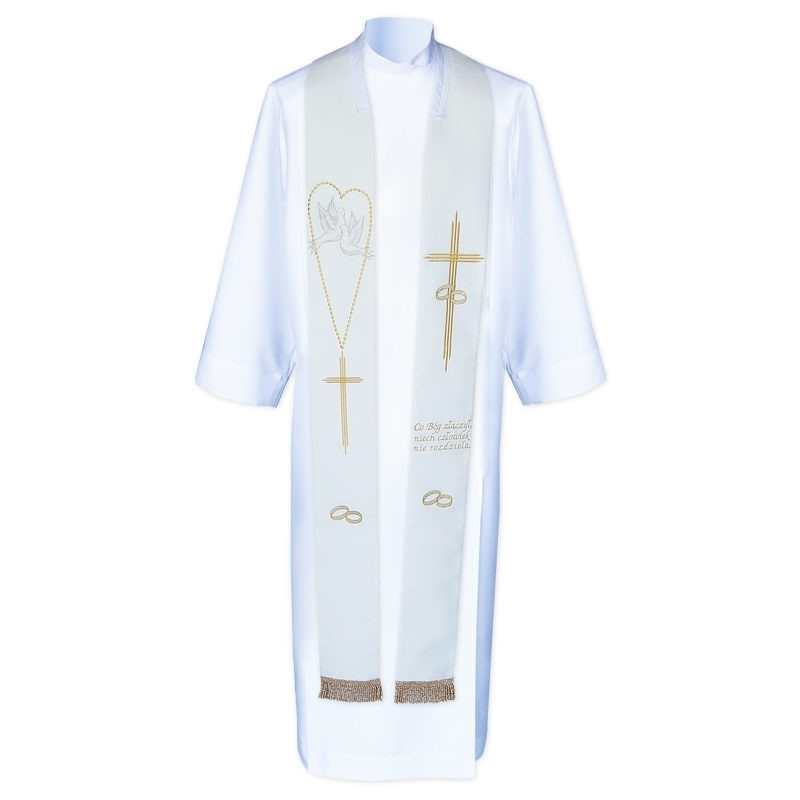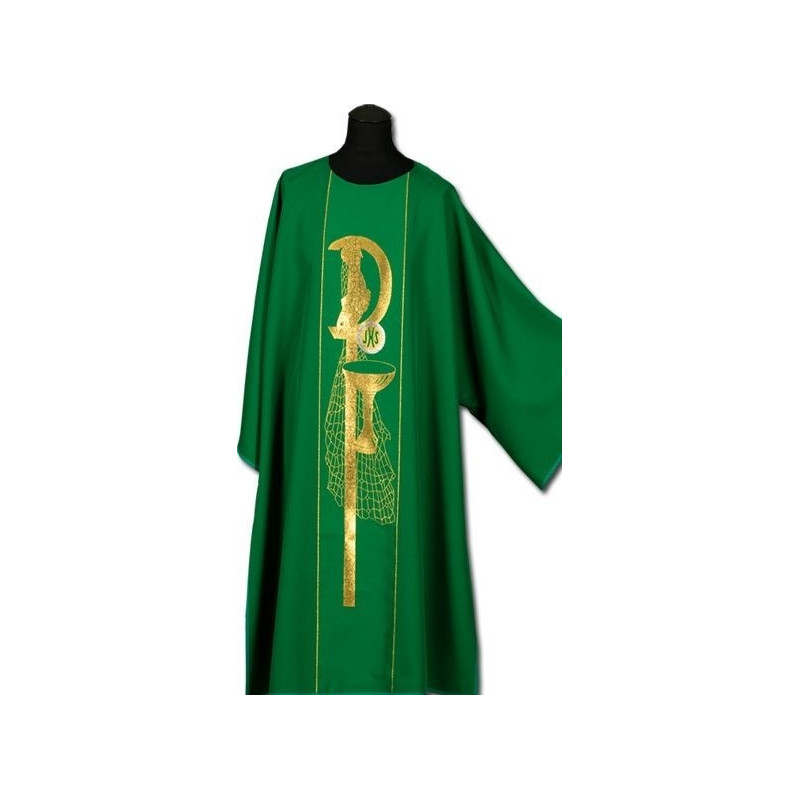


If you've ever watched a solemn Mass with a deacon, you've probably noticed a distinctive vestment he wears over his alb and stole. That's the dalmatic — one of the most recognizable pieces of liturgical clothing in the Catholic Church.
In this guide I'll answer the questions I hear most often: what a dalmatic actually is, who may wear it, when it's used, how it differs from a chasuble and a tunicle, and what to look for when choosing one for your parish.
What Exactly Is a Dalmatic?
A dalmatic is a long, wide-sleeved tunic worn by deacons during Mass and other liturgical functions. It is worn over the alb and the stole, and it usually matches the colour of the priest's chasuble, creating a visual unity between the two ministers at the altar.
The word comes from Dalmatia, a region on the Adriatic coast (modern-day Croatia), where this style of garment originated in the Roman Empire. In ancient Rome the dalmatic was a common outer garment; the Church adopted it as the distinctive vestment of the deacon, and it has been part of the diaconal wardrobe ever since.
Browse our collection of embroidered dalmatics — 45 vestments in every liturgical colour, from $70, most with a matching deacon stole.
Who Wears the Dalmatic?
The dalmatic is worn by deacons — both transitional deacons (those preparing for priesthood) and permanent deacons. It is the proper vestment of the diaconate, just as the chasuble is the proper vestment of the priesthood. Under it the deacon wears the diagonal deacon stole, the vestment that marks his order.
Two more cases are worth knowing. A bishop wears a dalmatic under the chasuble at solemn pontifical Masses — a sign of the fullness of Holy Orders, since the bishop wears all three degrees (deacon, priest, bishop) in his vestments. And the Pope, as Bishop of Rome, likewise wears a dalmatic under the chasuble on the most solemn occasions.
A priest wears a dalmatic only exceptionally — for example when concelebrating in place of a deacon — and this is uncommon in ordinary parish life.
When Is the Dalmatic Worn?
The dalmatic is worn at Mass whenever a deacon is serving, in the colour of the day — green for Ordinary Time, violet for Advent and Lent, white for Christmas and Easter, red for Pentecost and martyrs' feasts.
Outside of Mass, the dalmatic may be worn at solemn processions, Benediction of the Blessed Sacrament, baptisms, weddings and funerals celebrated with a deacon. Outside liturgical functions, deacons wear clerical dress, not vestments.
What Does the Dalmatic Look Like?
A typical dalmatic is a knee-length tunic with wide sleeves and openings at the sides for freedom of movement. It is usually decorated with embroidery — most commonly vertical bands (orphreys) running down the front and back, often matching the chasuble set.
| Feature | Dalmatic | Chasuble |
|---|---|---|
| Worn by | Deacon | Priest/Bishop |
| Sleeves | Wide, open sleeves | Sleeveless |
| Length | Knee-length or longer | Mid-calf to ankle |
| Worn over | Alb and stole | Alb and stole |
| Color | Matches liturgical season | Matches liturgical season |
| Decoration | Orphrey bands (front/back) | Orphrey bands (front/back) |
Dalmatic vs Chasuble vs Tunicle
The chasuble is the sleeveless outer vestment of the priest celebrant; the dalmatic is the wide-sleeved vestment of the deacon. They are worn at the same Mass, in the same colour, and normally from the same fabric set — see our full comparison: dalmatic vs chasuble.
The tunicle is a close relative of the dalmatic: narrower in the sleeves and more simply decorated. It was historically worn by the subdeacon in the Traditional Latin Mass, and by a bishop under the dalmatic at pontifical functions. In modern use the tunicle and dalmatic are often indistinguishable; the difference lies in who wears it and the role served. We explain both in dalmatic vs tunicle.
Gothic vs Roman Dalmatics
Dalmatics come in two great stylistic traditions. Gothic dalmatics feature a Y-shaped orphrey on the front and back, a hood-like fold at the neck, and richly patterned fabrics — our Gothic models run from $234 to $371. Roman dalmatics have a straight cross on the front, simpler lines, and a lighter look — our Roman models run from $200 to $355. Both are correct for the Ordinary Form; the choice is a matter of your church's artistic tradition. We compare them in detail in Gothic vs Roman dalmatics.
Fabrics and Embroidery
The fabric determines how a dalmatic drapes, wears and cleans. The most common weaves are jacquard (patterns woven into the cloth, so they never wash out), damask (a reversible figured fabric with a subtle sheen), brocade (a raised, richly patterned weave, often with metallic thread), and velvet — usually as decorative stripes and bands. Most of our dalmatics are cut from durable polyester blends: they resist creasing and dirt, keep their colour, and tolerate standard washing and ironing — practical for a vestment worn every week.
How to Choose a Dalmatic for Your Parish
Match the chasuble set. The deacon should look like part of the same liturgical ensemble as the priest. If your parish uses Gothic chasubles, choose a Gothic dalmatic; for Roman chasubles, a Roman one.
Check the fit. The dalmatic should allow free movement of the arms — the deacon holds the book, carries the Gospel, and assists at the altar. Our dalmatics measure 123–127 cm in length and 128–150 cm in width, with lining and size adjustment available on request.
Start with the colours you use most. For most parishes that means green (Ordinary Time), white, red and violet. A plain or IHS-embroidered dalmatic with a matching stole is the most versatile first purchase — our IHS models cost $161–$169, and a lector's dalmatic starts at $70.
Consider the fabric care. Modern jacquard and damask vestments are far easier to maintain than antique silk ones — they can be washed, ironed and stored without specialist care. See our guide to caring for embroidered vestments.
Frequently Asked Questions
Q: Is the dalmatic required for deacons at Mass?
A: It's not strictly required, but it's the proper vestment for the diaconate. Most dioceses and parishes expect deacons to wear it. If a dalmatic isn't available, the deacon may wear just the alb and stole.
Q: Can a permanent deacon wear a dalmatic?
A: Yes. The dalmatic is the vestment of all deacons — both transitional and permanent. There's no distinction in the liturgical books.
Q: Can a priest wear a dalmatic?
A: A priest may wear a dalmatic under the chasuble when concelebrating or when no deacon is present, but this is uncommon. Normally the priest wears the chasuble and the dalmatic is reserved to the deacon.
Q: Does the pope wear a dalmatic?
A: Yes. As Bishop of Rome, the Pope wears a dalmatic under the chasuble at solemn pontifical Masses, together with the other pontifical vestments.
Q: How much does a dalmatic cost?
A: Our dalmatics range from $70 (a lector's dalmatic) to $371 (ornate Gothic jacquard and damask models). Most embroidered dalmatics cost between $148 and $199, and most come complete with a matching deacon stole.
Q: Does the dalmatic need to be blessed?
A: Traditionally, liturgical vestments are blessed before use. The blessing can be given by a priest. It's not strictly required, but it's a beautiful tradition that sets the vestment apart for sacred use.
Q: How is "dalmatic" pronounced?
A: /dælˈmætɪk/ — "dal-MAT-ik", with the stress on the second syllable.
Conclusion
The dalmatic is a beautiful and ancient vestment that connects the deacon to the long tradition of the Church. It's simple, dignified and practical — everything a liturgical vestment should be. If you're outfitting a deacon in your parish, the dalmatic is an essential piece of the wardrobe.
Browse our embroidered dalmatics, matched with our chasuble lines and deacon stoles — options for every liturgical season and budget.