
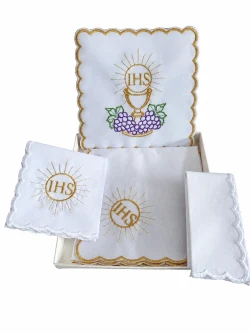
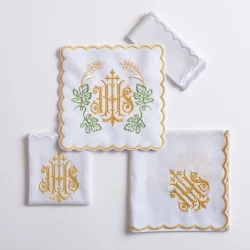


A chalice linen set is a matched group of altar linens used at Mass around the chalice. A typical four-piece set includes a pall, corporal, purificator and lavabo towel. Some sets are three-piece, while others add a chalice veil, burse and maniple in the matching liturgical color.
Our collection brings together more than 190 embroidered chalice linen sets from $27 to $141, including white, red, green, purple, black and rose sets for parish sacristies, chapels, religious houses and home Mass kits. Because the pieces, fabrics and sizes vary from set to set, the most important step is to check exactly what is included before you order.
What Is Included in a Set
The four pieces below are the core of a standard chalice linen set. The pall covers the chalice, the corporal provides a clean surface for the chalice and paten, the purificator wipes the chalice, and the lavabo towel dries the priest's hands after the washing of hands.
| Piece | Purpose at Mass | Typical size | Common material |
|---|---|---|---|
| Pall | Stiffened square placed over the chalice to protect the Precious Blood from dust and insects. | About 18 × 18 cm (7 × 7 in) | Cotton, linen or polyester with a stiff insert |
| Corporal | Square cloth on which the chalice and paten rest; it catches any particles of the host. | About 45 × 45 cm (17.7 × 17.7 in) | White linen or cotton |
| Purificator | Rectangular cloth used to wipe the chalice after the Precious Blood is consumed. | About 45 × 35 cm (17.7 × 13.8 in) | Absorbent linen or cotton |
| Lavabo towel | Finger towel used by the priest to dry his hands after the lavabo. | About 45 × 35 cm; some are smaller finger towels | Linen or cotton |
Some sets also include a chalice veil (about 51 × 51 cm), a burse (about 18 × 18 cm) for carrying the folded corporal, and a maniple (about 43 cm). These pieces are usually made in the same fabric and color as the rest of the set.
Chalice Linen Set vs Chalice Veil Set vs Altar Linen Set
The names are often used loosely, but they describe different groupings. A chalice linen set focuses on the linens used with the chalice: pall, corporal, purificator and lavabo towel. A chalice veil set usually means the veil, burse and maniple that cover and carry the vessels; it may not include a corporal or purificator. An altar linen set is broader and may include the fair linen or altar cloth as well as the chalice linens.
If you are equipping a sacristy from scratch, compare the altar tablecloths, chalice veils and burses separately so that every piece matches. If you only need the vessels covered for Mass, a four-piece chalice linen set is usually the simplest choice.
How Many Pieces You Need
Most parishes and priests need at least a four-piece set for the chalice. Three-piece sets are common where the pall is purchased separately or where a parish already has palls in stock. Sets that include a veil, burse and maniple are useful when the chalice is carried in procession or when the sacristy follows the fuller traditional arrangement.
| Set type | Usually includes | Best for |
|---|---|---|
| Three-piece set | Corporal, purificator, lavabo towel | Sacristies that already have palls |
| Four-piece set | Pall, corporal, purificator, lavabo towel | The standard set for most parishes and priests |
| Veil and burse set | Chalice veil, burse, maniple | Processions, solemn Mass, traditional sacristies |
| Full set | Pall, corporal, purificator, lavabo towel, veil, burse, maniple | New sacristies, religious houses, complete color sets |
If you need palls only, see our embroidered chalice palls, including white chalice palls and black chalice palls.
Materials: Linen, Cotton, or Polyester
Material affects absorbency, durability, ironing and price. Many of our sets use 100% cotton for the corporal, purificator and lavabo towel; some palls use a polyester or 100% PE stiffened insert because it holds its shape and resists staining. Other sets use linen or linen-blend fabrics. The product description always states the material for that specific set, so read it before comparing prices.
| Material | Strengths | Things to know |
|---|---|---|
| Linen | Absorbent, traditional, softens with washing | Wrinkles easily; iron while damp |
| 100% cotton | Absorbent, easy to wash, widely available | Can shrink; follow the care label |
| Polyester / 100% PE | Holds a crisp shape, stain-resistant, durable | Less absorbent; common in pall inserts |
Sizes for a Standard Chalice
Most chalice linens follow traditional proportions, but sizes can vary by maker. The pall should cover the mouth of the chalice; the corporal should be large enough for the chalice and paten; the purificator and lavabo towel should be long enough to drape over the hand. Measure your chalice and check the product dimensions before ordering.
| Piece | Typical size | What to check |
|---|---|---|
| Pall | 18 × 18 cm / 7 × 7 in | Should cover the chalice mouth without overhanging too far |
| Corporal | 45 × 45 cm / 17.7 × 17.7 in | Must hold the chalice and paten comfortably |
| Purificator | 45 × 35 cm / 17.7 × 13.8 in | Enough length to wipe the chalice without touching the floor |
| Lavabo towel | 45 × 35 cm; some are smaller | Comfortable for the priest to dry his hands |
| Chalice veil | 51 × 51 cm / 20 × 20 in | Should cover the chalice fully when draped |
| Burse | 18 × 18 cm / 7 × 7 in | Must fit the folded corporal |
Related: For the red set used at Pentecost and martyrs' feasts, see our red chalice palls.
Liturgical Colors and When to Use Them
Chalice linens normally match the liturgical color of the day. White is used for Christmas, Easter, feasts of the Lord and Our Lady, and many solemnities; red for Pentecost, Good Friday, the Passion and feasts of martyrs; green for Ordinary Time; purple or violet for Advent and Lent; black for funerals and Requiem Masses; rose for Gaudete and Laetare Sundays. Always follow the current liturgical calendar and local diocesan norms.
We stock sets in the main liturgical colors, including white, black, purple, red, green and rose. If you need a complete color set for a sacristy, order the same motif across colors where available.
How to Choose a Chalice Linen Set
- Check the included pieces. Confirm whether the set is three-piece, four-piece, or includes a veil, burse and maniple.
- Match the liturgical color. Buy the colors your parish uses most often first, then add seasonal colors.
- Read the material. Cotton and linen are absorbent; polyester palls hold their shape. The product description states what is used.
- Check the sizes. Compare the pall, corporal and purificator dimensions with your chalice and paten.
- Choose the embroidery. IHS, Jerusalem cross, Lamb of God, Marian, Franciscan and Eucharistic motifs are all available; choose a style that suits the sacristy.
- Plan for care. Confirm whether the set is machine washable and whether the pall has a removable insert.
- Consider the occasion. A four-piece set is a practical ordination, first Mass or priest anniversary gift; a full set suits a new sacristy.
How to Care for Chalice Linens
Wash chalice linens separately from ordinary laundry, using a mild detergent and warm water. Do not use bleach or harsh stain removers on embroidered pieces. Rinse thoroughly, roll in a towel to remove excess water, and iron while slightly damp on the reverse side. Store linens flat or rolled; avoid sharp folds that can crease embroidery. Follow the care label on each product and your diocesan sacristy norms.
Palls with a stiff insert should be cleaned according to the maker's instructions; remove the insert if the product description says it is removable. Purificators and corporals should be kept scrupulously clean and laundered regularly, especially after use with the Precious Blood.
What Are the Five Sacred Linens?
The five altar linens most often listed are the fair linen or altar cloth, the corporal, the purificator, the pall and the lavabo towel. Some sacristies also count the chalice veil and burse among the linens, but they are coverings for the vessels rather than the five core linens. The amice, alb and cincture are vestments, not altar linens.
Frequently Asked Questions
What is a chalice linen set?
A chalice linen set is a group of altar linens used at Mass around the chalice. A standard four-piece set includes a pall, corporal, purificator and lavabo towel; fuller sets may add a chalice veil, burse and maniple.
What pieces are included in a chalice linen set?
Most four-piece sets include a pall, corporal, purificator and lavabo towel. Three-piece sets usually omit the pall. Veil and burse sets include the chalice veil, burse and sometimes a maniple instead of the corporal and purificator. Always check the product description for the exact contents.
What is the difference between a chalice linen set and an altar linen set?
A chalice linen set focuses on the linens used with the chalice: pall, corporal, purificator and lavabo towel. An altar linen set is broader and may include the fair linen or altar cloth as well as the chalice linens.
What size pall do I need?
A common pall size is 18 × 18 cm (7 × 7 in), but measure the mouth of your chalice and check the product dimensions. The pall should cover the chalice without overhanging too far.
What size corporal do I need?
A common corporal size is 45 × 45 cm (17.7 × 17.7 in). It should be large enough for the chalice and paten to rest on it comfortably.
What is a purificator used for?
The purificator is the rectangular cloth used to wipe the chalice after the Precious Blood is consumed. It is usually made of absorbent linen or cotton and is often marked with a small cross.
What is a lavabo towel?
The lavabo towel, also called a finger towel or manuterge, is used by the priest to dry his hands after the washing of hands at the lavabo. It is usually about 45 × 35 cm, though smaller finger towels are also available.
Do I need a chalice veil and burse?
They are not required for every Mass, but they are customary in many sacristies. The veil covers the chalice before and after the consecration, and the burse carries the folded corporal. Both usually match the liturgical color.
What material is best for chalice linens?
Linen and cotton are absorbent and traditional for corporals, purificators and lavabo towels. Polyester or 100% PE is common for pall inserts because it holds a crisp shape and resists staining. Choose based on absorbency, care and the look you want.
Can chalice linens be machine washed?
Many sets are machine washable on a gentle cycle, but always follow the care label. Remove removable pall inserts, use mild detergent, avoid bleach, and iron while slightly damp.
How often should chalice linens be washed?
Wash them regularly according to parish practice and after any visible stain. Corporals and purificators that contact the Precious Blood should be laundered promptly and handled reverently, following diocesan norms.
What colors are available?
Our sets include white, red, green, purple or violet, black and rose, with some ecru and gold options. Choose the color for the liturgical season or feast, and follow the current calendar and local norms.
What is a maniple?
The maniple is a small ornamental band worn on the left arm in the traditional Roman rite. It is optional in the ordinary form and is often included in veil and burse sets for traditional or solemn celebrations.
How do I fold a corporal?
Fold the corporal in thirds lengthwise, then in thirds crosswise, so the embroidered cross remains visible when it is placed in the burse. Follow your sacristy's custom for the exact fold.
Are chalice linen sets good gifts?
Yes. A four-piece set is a practical gift for ordination, first Mass, a priest anniversary or a seminary student. Confirm the liturgical color and the pieces included before ordering.
Related Reading
- What Is a Corporal? A Guide to the Altar Linen
- Purificator vs Corporal: What's the Difference?
- How to Fold a Purificator
- What Is an Altar Cloth? Names, Rules and the Five Sacred Linens
- How to Wash Liturgical Linens
- What Is a Chalice Pall? Meaning, Sizes and Use at Mass
Explore the Collection
Complete your sacristy with individual corporals, purificators, palls and lavabo towels, or add a matching chalice veil and burse. For the altar itself, see altar tablecloths, chalices, ciboria and lavabo sets.
