

A holy water bucket is called an aspersorium — from the Latin aspergere, "to sprinkle." That is the proper liturgical name for the portable vessel that holds the water a priest sprinkles with the aspergillum. Around the church, though, you will hear several other names, and each one means something slightly different.
The proper name: aspersorium
An aspersorium is any portable vessel — pot, bucket, or bowl — that holds holy water for sprinkling. Large handled aspersoriums are carried in processions and at the blessing of homes; small ones sit on the credence table at Mass. The word appears in museum catalogs, liturgical manuals, and now in your search bar: it is the answer to "what is a holy water bucket called?"
The fixed vessels: stoup and holy water font
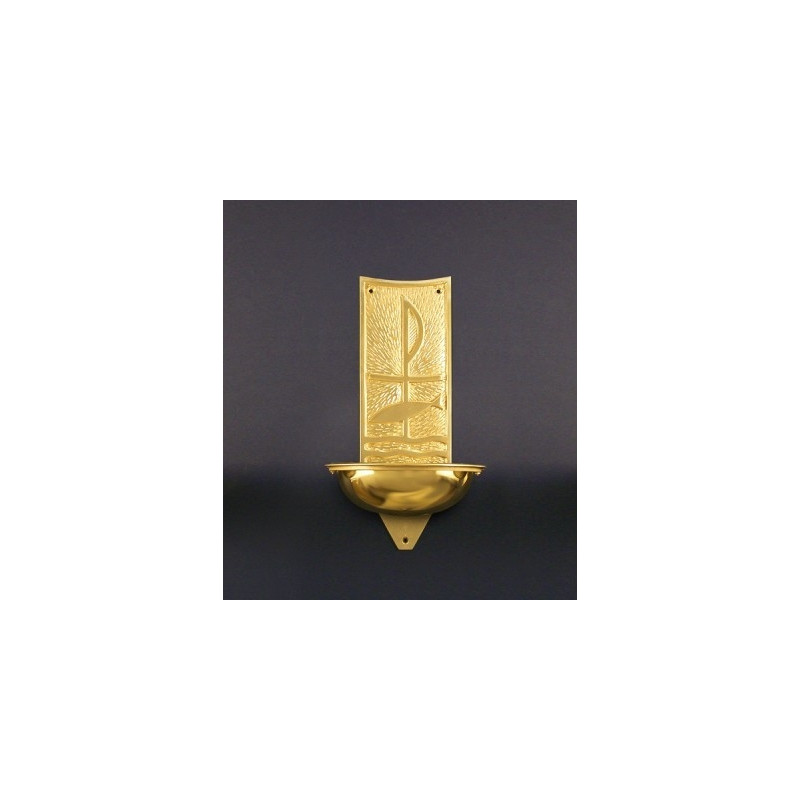
A stoup is a small vessel, usually wall-mounted, fixed at the church or home entrance so the faithful can dip their fingers and make the Sign of the Cross. A holy water font is the general name for any vessel that holds holy water — the stoup at the door, the standing font in the nave, or the small font at home. Fixed vessels stay in place; the aspersorium travels.
The plain-English names: bucket, container, holder, receptacle
People searching for this vessel use many words — holy water bucket, container, holder, receptacle, vessel, jug, kettle, basin — and all of them are correct in ordinary speech. The differences are only about shape and use: a bucket has a handle for carrying; a jug or kettle pours; a bowl or basin sits still on a table or floor. In our collection you will find all three shapes: a stainless steel bucket-kettle, a polished nickel bowl-jug, and a full brass pot-and-sprinkler set.
What it is not: a baptismal font
A baptismal font is a different vessel: the large basin, fixed in the baptistery, in which baptism is administered. It is often confused with the holy water font because of the shared word, but the baptismal font is the place of the sacrament itself — it is never carried, and holy water for sprinkling is not drawn from it in ordinary parish use. The aspersorium, the stoup, and the holy water font are the blessing vessels; the baptismal font is the sacrament vessel.
Which vessel belongs where?
| Setting | Vessel | Why |
|---|---|---|
| Church entrance | Stoup / holy water font | The faithful bless themselves on the way in and out |
| Sacristy & Mass | Aspersorium (pot/bucket) + aspergillum | The sprinkling rite and the blessing of homes |
| Home | Small font, bottle, or pot | Daily blessing at the door; family prayer |
| Processions | Large handled aspersorium | Carried with the aspergillum along the route |
What a holy water bucket is made of — and how it is finished
Buckets and aspersoriums are made from metals that will not corrode or taint the water: brass, gold-finished brass, nickel-plated metal, and stainless steel. The finish follows the metal — a warm gold tone on polished brass, bright silver on nickel plating, a clean grey on stainless — and most brass pieces carry a clear, heat-cured lacquer so they ask only for a dry, soft cloth. Better buckets also include a removable inner bowl, or liner: a plastic insert that keeps the water off the metal and cleans up with a rinse. In our holy water bucket and pot collection, the complete set includes a protective inner bowl and a sponge dropper that holds the holy water sprinkler upright.
Sizes, capacity, and what a bucket costs
Holy water buckets are sized by what they have to do. A sacristy bucket-kettle carries and pours water for refilling fonts; a 19 cm (7.5 in) bowl-jug serves blessings and sacristy work; large handled buckets of 41–44 cm (16.1–17.3 in) are made for processions and the blessing of homes. In our collection, the stainless steel bucket-kettle starts at $201, the nickel bowl-jug is $242, and the complete brass pot-and-sprinkler set — the classic parish arrangement — is $383. All three ship free within the United States over $100. Comparable ornate brass sets from other church suppliers often exceed $600, so it pays to compare materials and sizes piece by piece.
Frequently Asked Questions
Q: What is the bucket that holds holy water called?
A: It is called an aspersorium — literally "the sprinkler's vessel." The word covers every portable form: the handled bucket, the deep pot, and the bowl-jug.
Q: What is a holy water container called?
A: In liturgical books, an aspersorium if it is portable and a stoup or holy water font if it is fixed. In everyday speech, any of these: bucket, container, holder, or receptacle.
Q: What is the difference between a stoup and an aspersorium?
A: A stoup is fixed at the entrance and stays there; an aspersorium is portable and is carried by the priest for sprinkling during the Rite of Asperges, blessings of homes, and processions.
Q: Is a holy water bucket the same as a holy water font?
A: Almost — both hold holy water, but the bucket (aspersorium) is portable and the font is fixed. A font can also be a large standing vessel, while the bucket is the working vessel of the sacristy.
Q: Where can I buy a holy water bucket?
A: Our holy water pot and bucket collection includes a stainless steel bucket-kettle, a nickel bowl-jug, and a complete brass pot-and-sprinkler set — all made in Poland and Italy. Pair your bucket with an aspergillum, and if you are choosing a fixed vessel for your church, start with our holy water font guide.
Q: What is a holy water bucket made of?
A: Traditionally brass, nickel-plated metal, or stainless steel — noble, non-corrosive metals that keep the water clean. Our buckets and pots use all three, finished with heat-cured lacquer on brass and left bright on nickel and stainless.
Q: How much does a holy water bucket cost?
A: In our collection: $201 for the stainless steel bucket-kettle, $242 for the polished nickel bowl-jug, and $383 for the complete brass pot-and-sprinkler set.
Conclusion
Whatever you call it — aspersorium, bucket, or holy water pot — the vessel has one job: to hold the water of blessing. Choose one that is clean, non-corrosive, and made to last, and keep a sprinkler with it. The names are many; the water is one.