 History & Traditions
Via Crucis Meaning: The Way of the Cross Explained
Via Crucis means “Way of the Cross.” Learn the history, the 14 stations, how the devotion is prayed, and why it is centr...

Historical context for liturgical practices and sacred objects
History & Traditions
Via Crucis means “Way of the Cross.” Learn the history, the 14 stations, how the devotion is prayed, and why it is centr...
 History & Traditions
What the star, the Magi, and the manger mean on a Christmas chasuble — and how to read the embroidery at Mass.
 History & Traditions
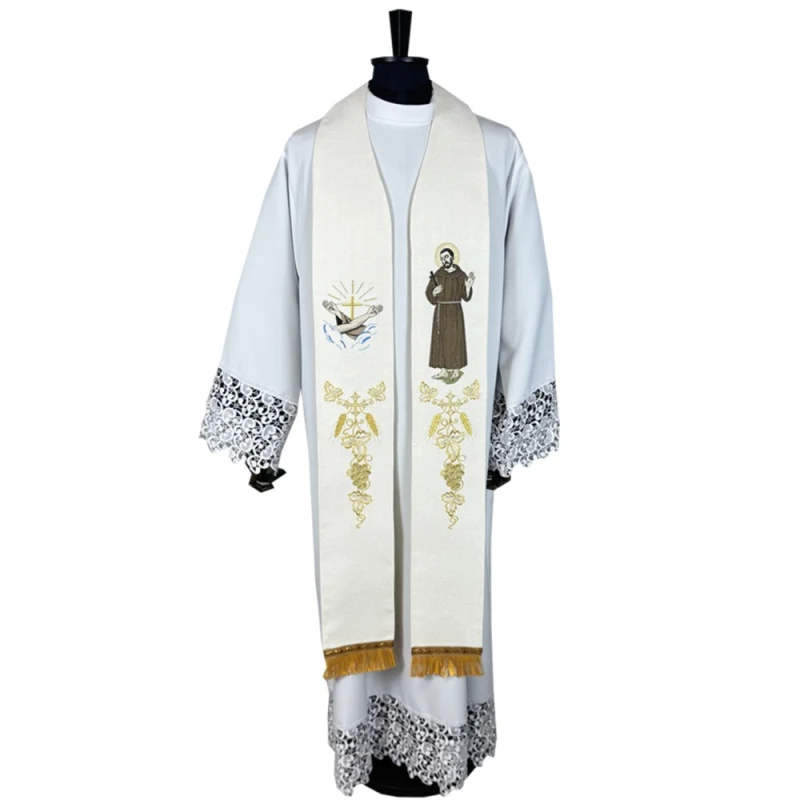
A patron saint stole is a priest stole with the image of a canonized saint, worn on the saint's feast day, at a parish p...
 History & Traditions
Keys, sword, lily, stigmata: the attributes embroidered on a stole identify the saint. Learn the most common symbols on...
 History & Traditions
The deacon stole is a sign of ordination and service. Here is what the diagonal position, the word diakonos, and the mom...
 History & Traditions
Catholic chalice veils and Orthodox aer and diskos veils serve different rites. Compare their names, shapes, use, and sy...
 History & Traditions
Vestment catalogs call it the capuche — the hooded alb. Learn where the hood comes from, why parishes choose it for serv...
 History & Traditions
Viaticum - the Church\u2019s final Communion - is \u201cfood for the journey\u201d given to the dying. Learn the meaning...
 History & Traditions
Gothic dalmatics carry a Y-shaped orphrey and a hood-like fold; Roman dalmatics a straight cross and simpler lines. Styl...
 History & Traditions
The Litany of Loreto worked in thread: the Immaculate Heart, the AM monogram, roses and lilies, the crown of twelve star...
 History & Traditions
One Mother, many titles: Guadalupe, Lourdes, Fatima, La Salette, Perpetual Help, Częstochowa, the Gate of Dawn, the Rosa...
 History & Traditions
A cross is the shape; a crucifix is a cross that carries the corpus of Christ. Here is the difference, where each is use...
